From Vine to Value — The Post-Harvest Decisions That Decide Your Profit
By Brian
Your fruit is ripe, gorgeous, and dropping off the vine. What you do in the next four hours decides whether you sell premium lilikoi at $6/lb or watch it shrivel in a week. The growing is the easy part — passion fruit does most of that work itself. The money is made or lost after it leaves the vine.
Here's the short version: cool the pulp to its storage target within four to six hours, store yellow at 45–50°F (never colder), and match your fruit to the right channel — fresh for the prettiest, frozen pulp for everything else. Get that sequence right and you stretch a two-week window into a five-week one and a seasonal crop into year-round income. Get it wrong and the best field in the islands still loses money on the loading dock.
Passion fruit picks itself — so let it
Most tropical fruit gets picked. Passion fruit picks itself. When it's truly ripe it abscises — detaches from the vine and drops — and that thick skin absorbs the impact without bruising. If the fruit is still hanging on, it isn't ready. That single fact is the most reliable harvest indicator you have.
The other signs back it up: at least 75% of the skin showing full color (bright yellow for lilikoi, near-black for purple), slight dimpling or wrinkling, and a tropical aroma you smell before you touch it. The fruit should feel plump with a little give. Flower to harvest runs about 70–75 days; yellow keeps coloring up to roughly day 83, purple hits near-black by day 75.
Do not pick green expecting it to finish on the counter. It won't. Passion fruit harvested before natural drop comes in with less juice, weak flavor, and low sugar — and no paper bag fixes that. Post-harvest work at the University of São Paulo measured the gap: fruit harvested at full physiological maturity (natural abscission) had 23% higher total soluble solids and 31% more juice volume than fruit picked before it detached.
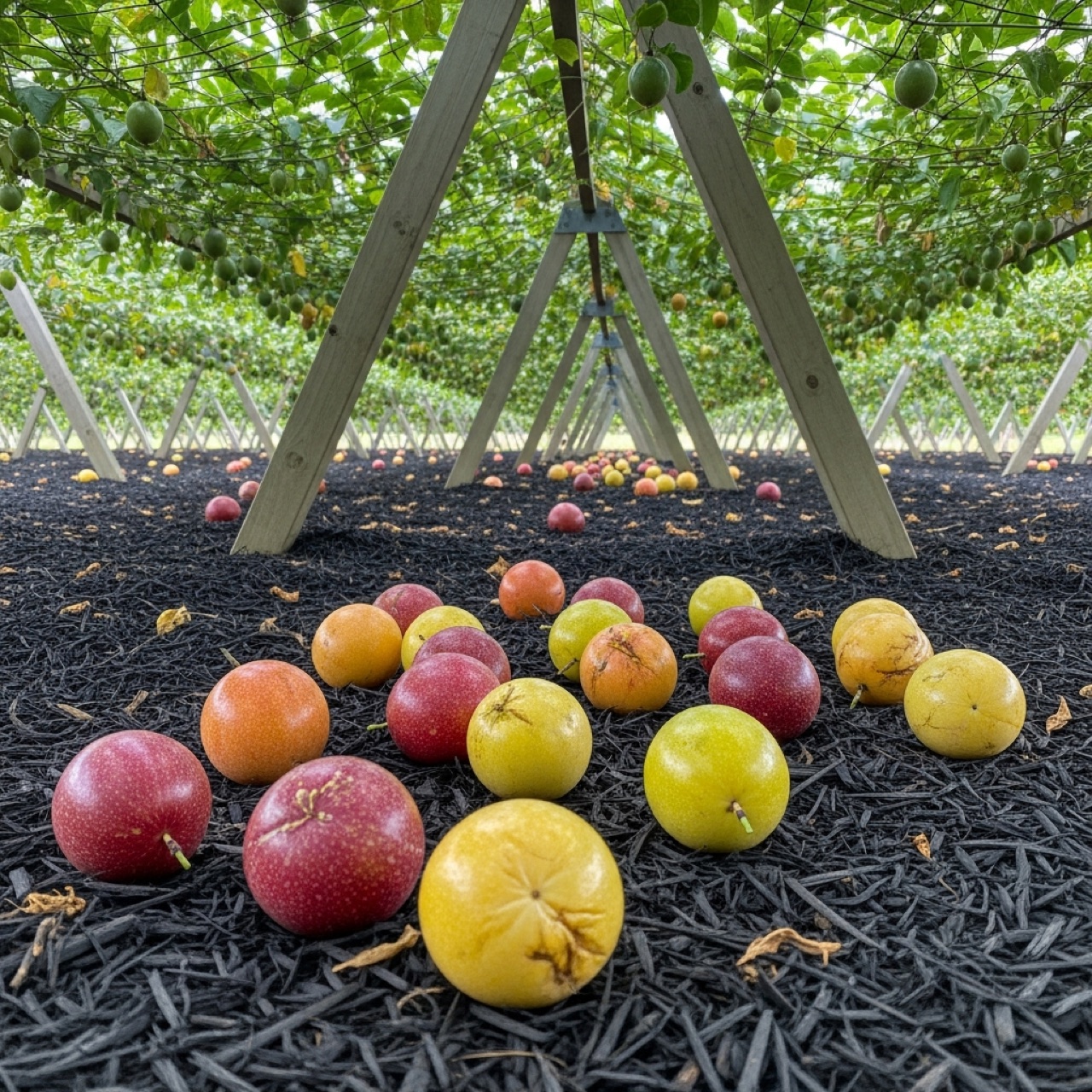
What this means for your farm: build your harvest routine around collection, not picking. Walk the rows daily during peak drop, gather what's on the ground, and resist the urge to clip hangers to fill a crate. The fruit tells you when it's ready.
The four-hour clock
From the moment the fruit drops, the clock is running. The handling sequence that preserves quality is simple and unforgiving:
- Field sort first. Pull anything sunburned, split, or insect-damaged before it goes in the crate. One rotting fruit contaminates the whole batch.
- Shallow crates only. One or two layers, max. Passion fruit bruises easier than it looks, and stacking weight crushes the bottom layer.
- Wash gently. A bubble wash lifts soil without the mechanical damage scrubbing causes. Dry immediately with forced air — surface moisture is the enemy in storage.
- Cool fast. Get pulp temperature to the storage target within four to six hours. Yellow lilikoi: 45–50°F. Purple: it tolerates cooler, 37–41°F.
- Wax after drying. A food-grade wax coating restores the surface protection washing strips off. USDA ARS protocols show it cuts water loss by up to 40% and stretches shelf life from about two weeks to three-to-five.
Storage reality check
Handled and cooled right, passion fruit stores three to five weeks. That sounds generous until you subtract transit, distributor handling, and retail display. Your real market window for fresh fruit is seven to ten days once it's fully ripe. At room temperature you've got about two weeks before it's past prime — and on a counter in a Hawaii kitchen, less.
| Room temperature, no cold chain | ~2 weeks | ~2 weeks | Backyard only |
| Cold storage, target temp | 3–5 weeks | 3–5 weeks | 7–10 days at retail |
| Storage temperature | 45–50°F (7–10°C) | 37–41°F (3–5°C) | — |
| Below 45°F (yellow) | Chilling injury | Tolerated | Avoid for yellow |
What this means for your farm: the cold chain isn't optional infrastructure for anyone selling past the farm gate. A small walk-in or even a dedicated reach-in, plus a forced-air cooling step, is the cheapest yield boost you'll ever buy — because every fruit you don't lose to shrivel is fruit you already paid to grow.
Where the money actually is: market channels
Here's what most growers don't plan for until they're drowning in peak-season fruit: your channel determines your return more than almost anything else. The spread runs from $0.90/lb at wholesale to $8/lb at the farmers market — nearly 9× for the same fruit.
| Farmers market (fresh) | $4–8/lb | Low | Highest price; labor-intensive, capped by what you can sell in a morning |
| Restaurants & hotels (fresh) | $2–4/lb | Medium | They pay for consistency; reliable weekly delivery earns a premium |
| Restaurants & hotels (frozen pulp) | $8–15/gal | Medium | Year-round supply; converts surplus into foodservice revenue |
| Wholesale distribution | $0.90–1.30/lb | High | Tight margins, one buyer, one delivery point — operational simplicity |
| Mainland wholesale (exported) | $2–4/lb | High | Above local wholesale; adds irradiation + freight cost |
The smart play for a medium-scale Hawaii operation: sell the prettiest fruit fresh at markets and to restaurants, and process everything else into frozen pulp during peak season. Use that pulp to feed foodservice accounts the other months of the year. You capture the high fresh price on your best fruit and stop bleeding the rest.
Surplus becomes year-round money: value-added
Value-added products — frozen pulp, concentrate, powder, seed oil — are where peak-season surplus that would otherwise rot becomes real revenue. Frozen pulp extends your selling season from roughly eight months to year-round and is the most practical first processing step at any scale beyond backyard. Dehydrated powder holds 18–24 months and ships anywhere. Passion fruit seed oil commands premium cosmetics pricing. Each step adds cost and regulatory complexity, but each one also turns waste into income.
| Frozen pulp | Year-round; foodservice-ready | First processing step for most operations |
| Juice concentrate | Extended; ships dense | Wholesale and beverage buyers |
| Lilikoi butter & syrup | Retail premium per lb | Direct-to-consumer, gift market |
| Dehydrated powder | 18–24 months; ships anywhere | Mainland and online sales |
| Seed oil | Premium cosmetics pricing | Niche, high-margin |
What this means for your farm: start with frozen pulp before anything fancier. It's the lowest-complexity step, it solves the peak-season glut directly, and it's exactly what your restaurant and hotel accounts want so they can buy from you in February. Build the kitchen and the labeling out from there.
Getting off the island
Exporting from Hawaii to the mainland is a regulatory step, not just a logistics one. Every shipment needs irradiation treatment at a 210–250 Gy dose to eliminate fruit-fly risk, and every interstate shipment needs a phytosanitary certificate — no exceptions. That adds cost and lead time, but mainland wholesale runs $2–4/lb, well above local wholesale, so the math can work.
Airfreight puts premium fresh fruit on West Coast shelves within 24 hours of harvest. Sea containers are for processed product — frozen pulp, concentrate, powder — where the slower transit doesn't matter and the lower freight cost does.
The certification that opens doors
GAP certification — Good Agricultural Practices — is technically voluntary and practically required for the channels growing fastest. Whole Foods requires it. Foodland is moving toward it. Hotels increasingly ask for food-safety documentation. Without it you're locked out, and the investment pays for itself the first time a buyer asks "are you GAP certified?" and you can say yes instead of losing the account.
Hawaii makes it relatively painless:
- HiFarmSafe (hifarmsafe.org) provides USDA GAP audits on a service-for-fee basis.
- CTAHR offers free education on implementation.
- Hawaii Department of Agriculture runs a food-safety certification program through its Commodities Branch.
The bottom line
Post-harvest handling isn't glamorous — nobody got into farming because they love cold-chain logistics. But the line between a profitable passion fruit operation and one that loses money almost always runs through what happens after the fruit leaves the vine.
Pick at the right time (let it drop). Cool it fast. Know your channels and match the fruit to them. Process the surplus into pulp. Get GAP certified. The fruit does the hard work of growing itself — your job is to not waste it on the way to market.
Sources
- Salomão, L.C.C. et al. (2016) — Post-harvest quality of passion fruit at different maturity stages, Postharvest Biology and Technology
- USDA Agricultural Research Service — Post-Harvest Handling and Storage of Passion Fruit (cold-chain and wax-coating protocols)
- University of Hawaii CTAHR Extension — post-harvest and food-safety guidance
- UF/IFAS Extension — passion fruit production and handling
- EMBRAPA Cerrados — passion fruit research
- HiFarmSafe (hifarmsafe.org) — USDA GAP audit services, Hawaii
- Hawaii Department of Agriculture — phytosanitary and food-safety certification (Commodities Branch)
New articles every other Wednesday
Get each new piece in your inbox. No spam, unsubscribe anytime.