What Actually Kills Passion Fruit Vines — and What Won't
By Brian
Most passion fruit growers lose vines. Not all of them, not all at once — but the question is never whether you'll face disease or pest pressure, it's whether you'll recognize the threat early enough to do something about it. The vines that fail almost always looked healthy right up until they didn't.
Here's the part that catches people off guard: the three diseases that can wipe out an entire planting are mostly invisible until it's too late, and the two reflexes growers reach for — spray harder, replant the dead spots — make some of them worse. Insecticides don't prevent the virus that kills plantings. Replanting into Fusarium-infected soil just kills the next round.
This is what Phase 6 of our research found, after pulling from CTAHR Hawaii, USDA ARS, UF/IFAS, EMBRAPA Brazil, and 58 peer-reviewed sources: the management practices that separate productive orchards from failed ones come down to a handful of decisions, most of them made before a problem is visible.
The three diseases that end plantings
Not all diseases are equal. Some cause cosmetic damage you can live with. Three can take the whole field. They attack different parts of the plant, spread by different routes, and demand completely different defenses — so the first job is telling them apart.
| Fusarium wilt | Fusarium oxysporum f. sp. passiflorae | Vascular system | Soil (persists 4 yrs) | Resistant rootstock |
| Phytophthora rot | P. cinnamomi / P. nicotianae | Crown & roots | Waterlogged soil, zoospores | Drainage / site design |
| Viral woodiness | CABMV / PWV (potyviruses) | Whole plant | Aphids (non-persistent) | Roguing + reflective mulch |
Fusarium wilt — the soil time bomb
Fusarium wilt (Fusarium oxysporum f. sp. passiflorae) is a soil-borne fungus that colonizes the vascular system and kills plants in 42–60 days. The progression is predictable enough to use as a diagnostic clock: pale new leaves in weeks 1–2, yellowing and leaf drop in weeks 3–4, complete collapse by weeks 6–8. If you cut the stem at the base and see dark brown vascular tissue instead of pale cream, Fusarium is almost certainly the cause.
The cruel part is what happens after the plant dies: the pathogen persists in the soil for up to 4 years. You can't just pull the dead vine and replant in the same hole. The primary — really the only reliable — defense is resistant rootstock: grafting onto yellow passion fruit (P. edulis f. flavicarpa) or the highly resistant P. mucronata genotypes G2 and G5.
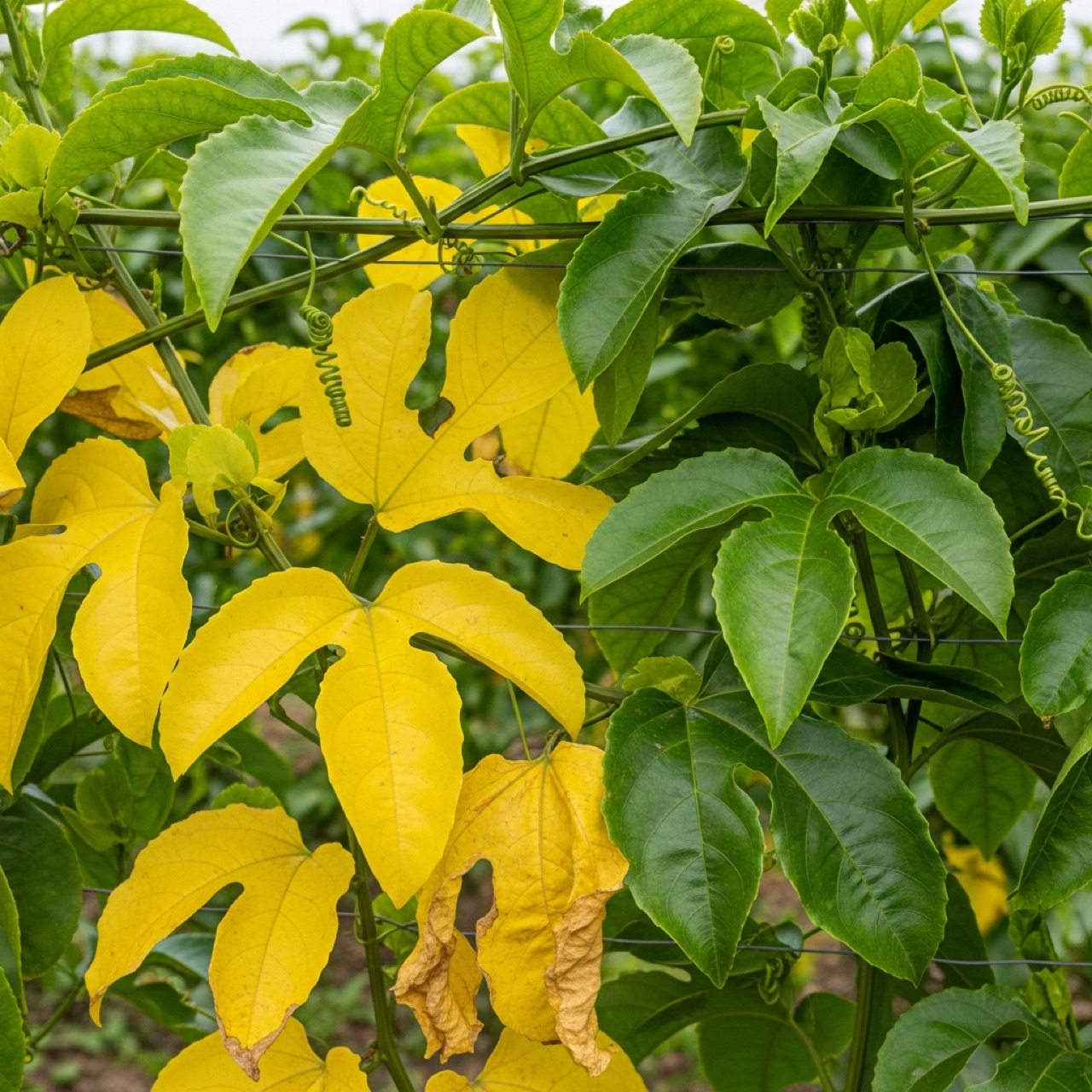
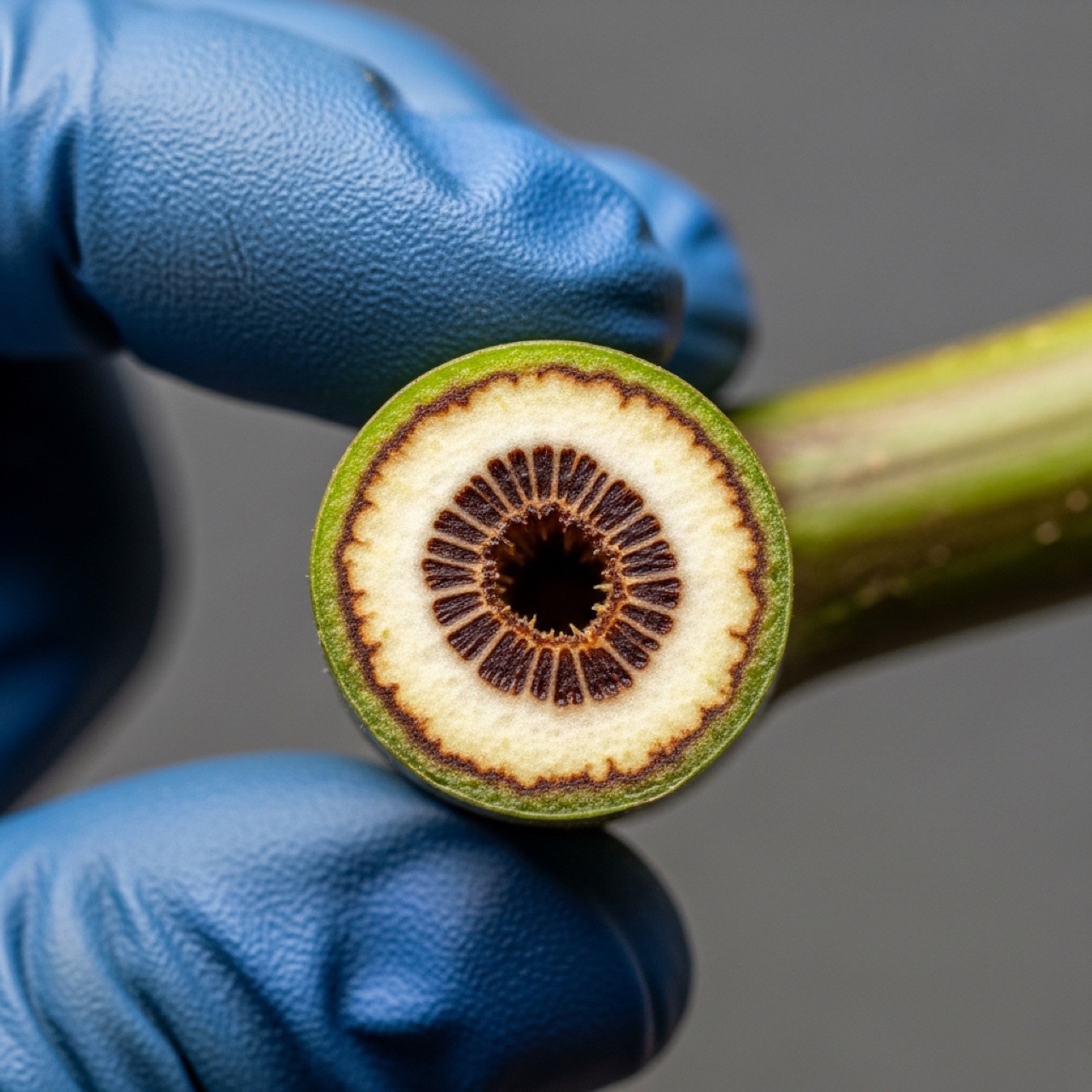
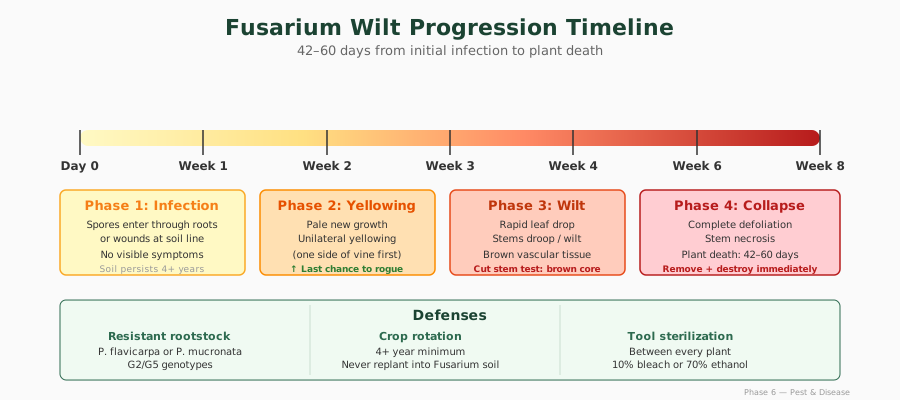
The grafting decision deserves its own chart, because the rootstock you choose is the whole defense. Resistant rootstock doesn't slow Fusarium down — it changes the outcome entirely.
| Own-root purple (P. edulis f. edulis) | Very low (~10%) | Standard purple on its own roots — highly susceptible |
| Yellow passion fruit (flavicarpa) | High (~80%) | The workhorse commercial rootstock; also confers nematode resistance |
| P. mucronata G2 | Very high (~92%) | Among the most resistant genotypes tested |
| P. mucronata G5 | Very high (~95%) | Top performer in EMBRAPA screening |
What this means for your farm: decide your rootstock before you order a single plant. In any soil with a Fusarium history — or any soil you can't certify clean — graft is not optional. Yellow rootstock is the practical default; P. mucronata G2/G5 are the insurance policy where the disease is established.
Phytophthora — the crown-zone blindspot
Phytophthora root and crown rot (P. cinnamomi and P. nicotianae) targets the crown zone — the junction where stem meets soil. That junction has naturally softer tissue, and Phytophthora's swimming zoospores accumulate in any standing water pooled at the base. Even brief waterlogging can initiate infection. Aboveground you'll see mild yellowing progressing to wilting and defoliation; below ground, roots turn dark brown to black and slimy.
There's no spraying your way out of this one. The fix is almost entirely preventive and almost entirely about site design made before planting: excellent drainage, raised beds if drainage is marginal, drip irrigation only (never overhead watering near the crown), and never planting in low-lying areas where water pools.
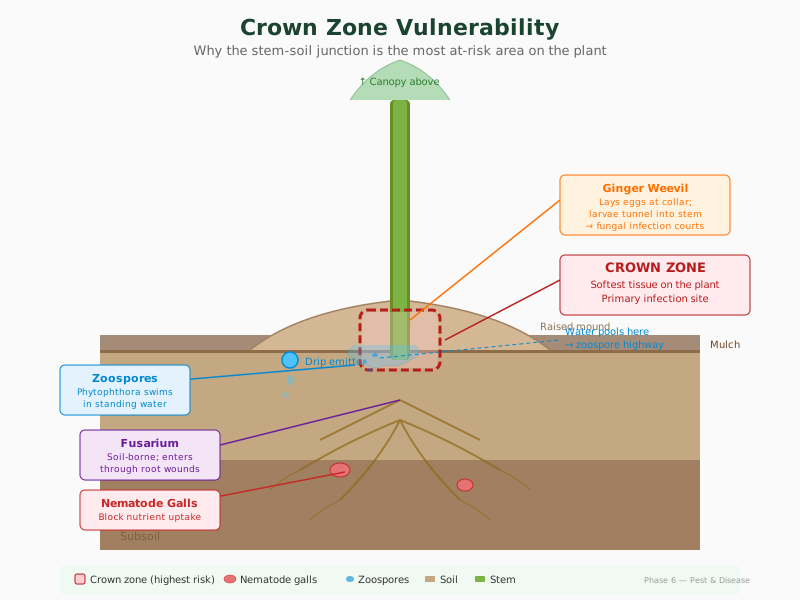
What this means for your farm: Phytophthora is won or lost on the day you choose where to dig. Fix drainage, mound the planting hills, and keep your drip emitters off the crown. If water stands at the base after a hard rain, that spot will eventually rot a vine — move the plant.
Viral woodiness — and why your insecticide is useless against it
Viral woodiness diseases (CABMV and PWV) are the third planting-killer, and the one most growers fundamentally misunderstand. These are potyviruses transmitted by aphids — and insecticides do not prevent transmission. The viruses move non-persistently: aphids acquire and transmit them during brief probes lasting seconds. The aphid doesn't need to colonize the plant. It probes, picks up virus, flies to the next plant, probes again, and transmits — all before any insecticide has time to act.
Spraying to kill aphids after they land is closing the barn door after the horse has already touched every vine in the row.
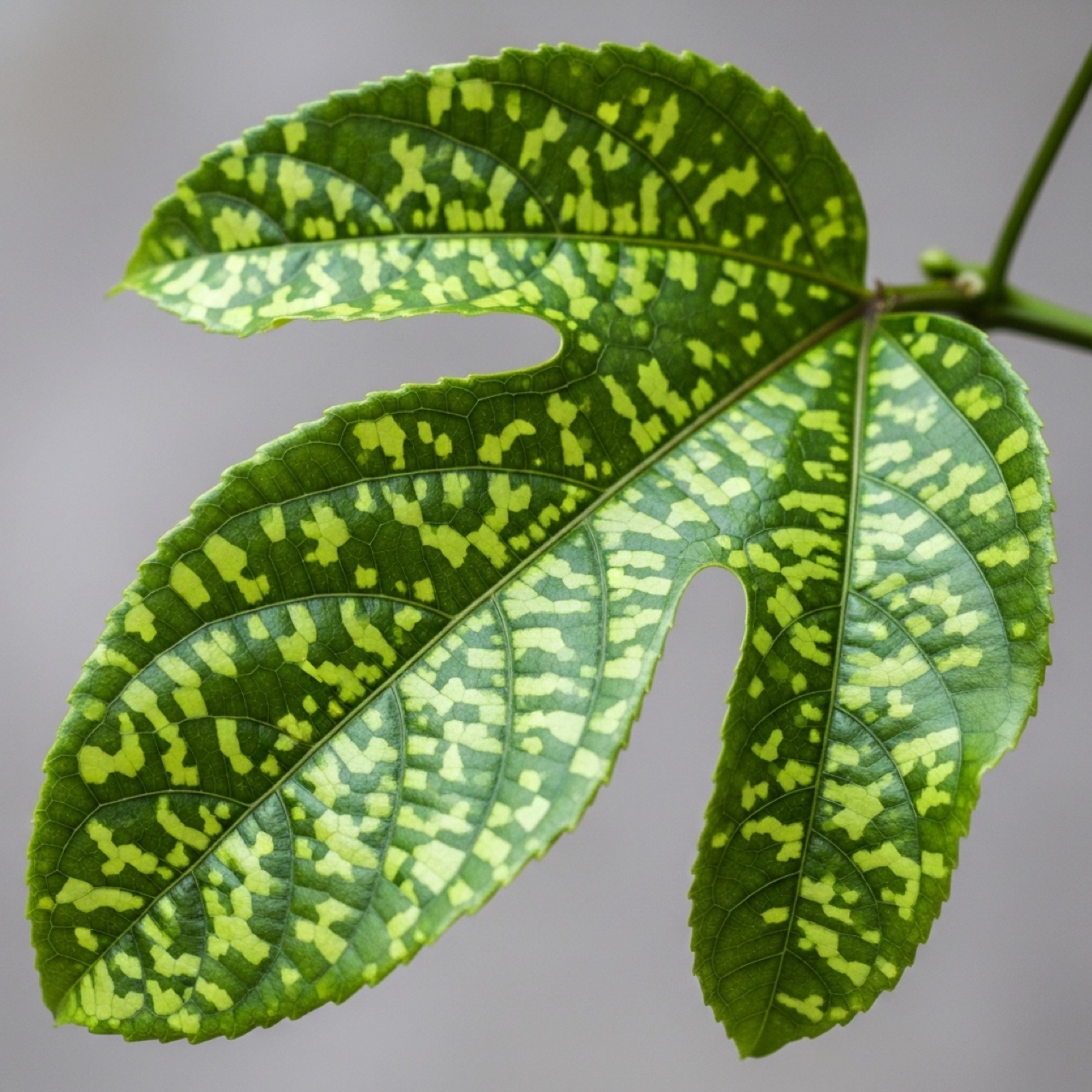
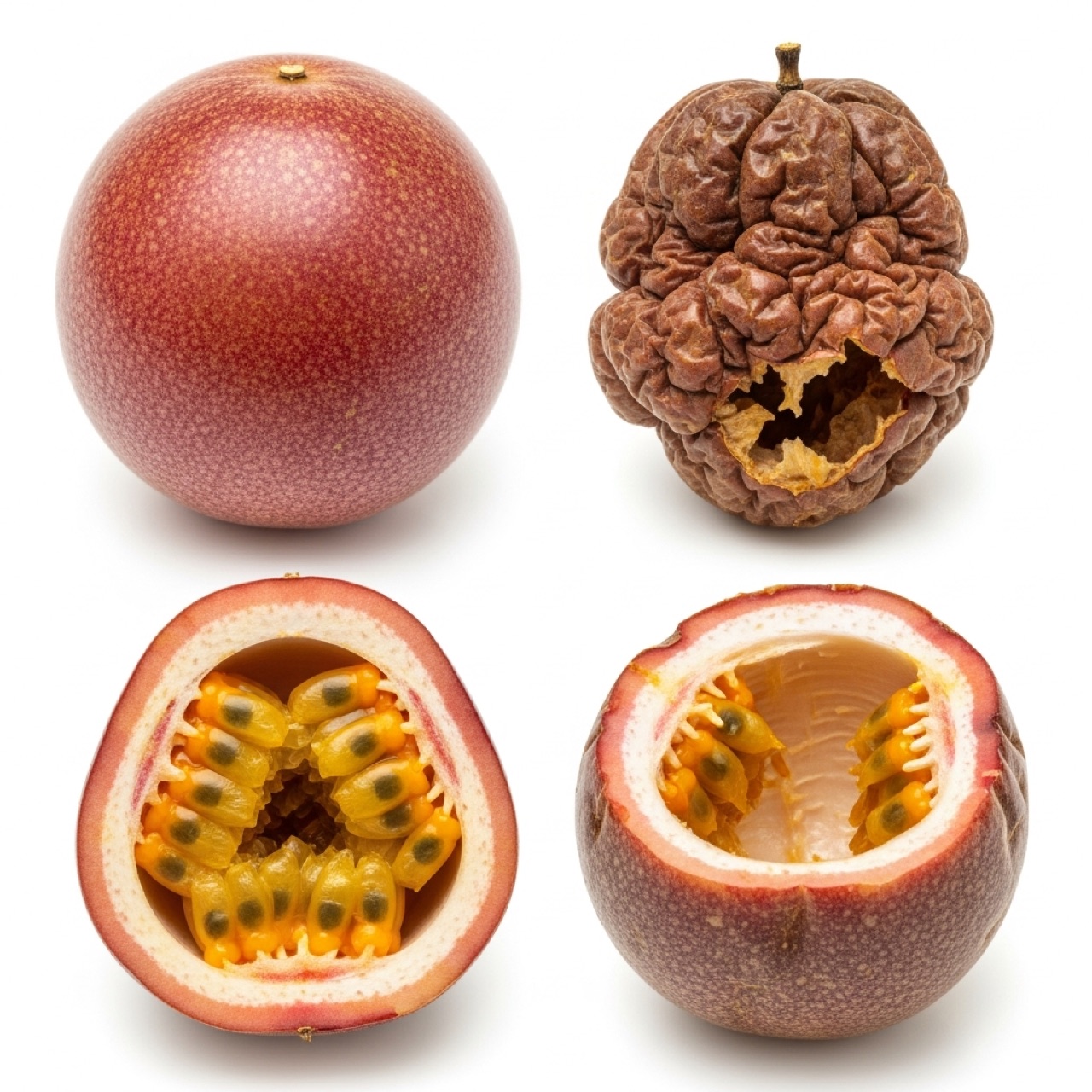
Without intervention, CABMV spreads through an entire crop in approximately 120 days. With systematic weekly roguing — inspecting every plant, removing and destroying any that show symptoms — infection stays around 8% after 180 days. That gap is the entire difference between a productive orchard and a total loss. The roguing study at ESALQ-USP Piracicaba found only 16% of vines needed removal over 25 months; the rest stayed productive.
| No intervention | Spreads through entire crop | ~120 days |
| Weekly roguing | ~8% infection, planting stays productive | 180 days |
| Reflective mulch vs. no mulch | ~10× fewer infected plants | Per-season |
| Roguing (Piracicaba trial) | Only ~16% of vines removed total | 25 months |
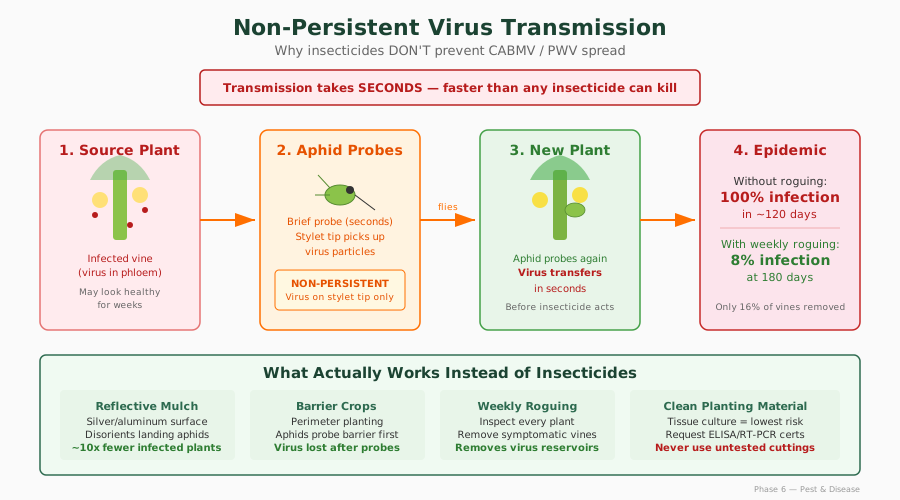
I cover the full prevention toolkit below — but the headline is that everything effective against virus works by stopping aphids from landing on or reaching your vines, not by killing them once they're there.
The root zone is where growers get blindsided
The stem-soil junction — the collar region — is the most vulnerable part of a passion fruit plant, and it's the part most growers never inspect. Two distinct problems live down there.
Collar rot is a disease complex: ginger weevil larvae tunnel into the stem tissue just above soil level, and two fungi (Lasiodiplodia theobromae and Nectria haematococca) colonize the tunnels. The plant rots from within. Visual signs are cracking and swelling at the base, dark lesions, and oozing from bark cracks. By the time aboveground symptoms appear — yellowing, vine dieback — the damage is often irreversible.
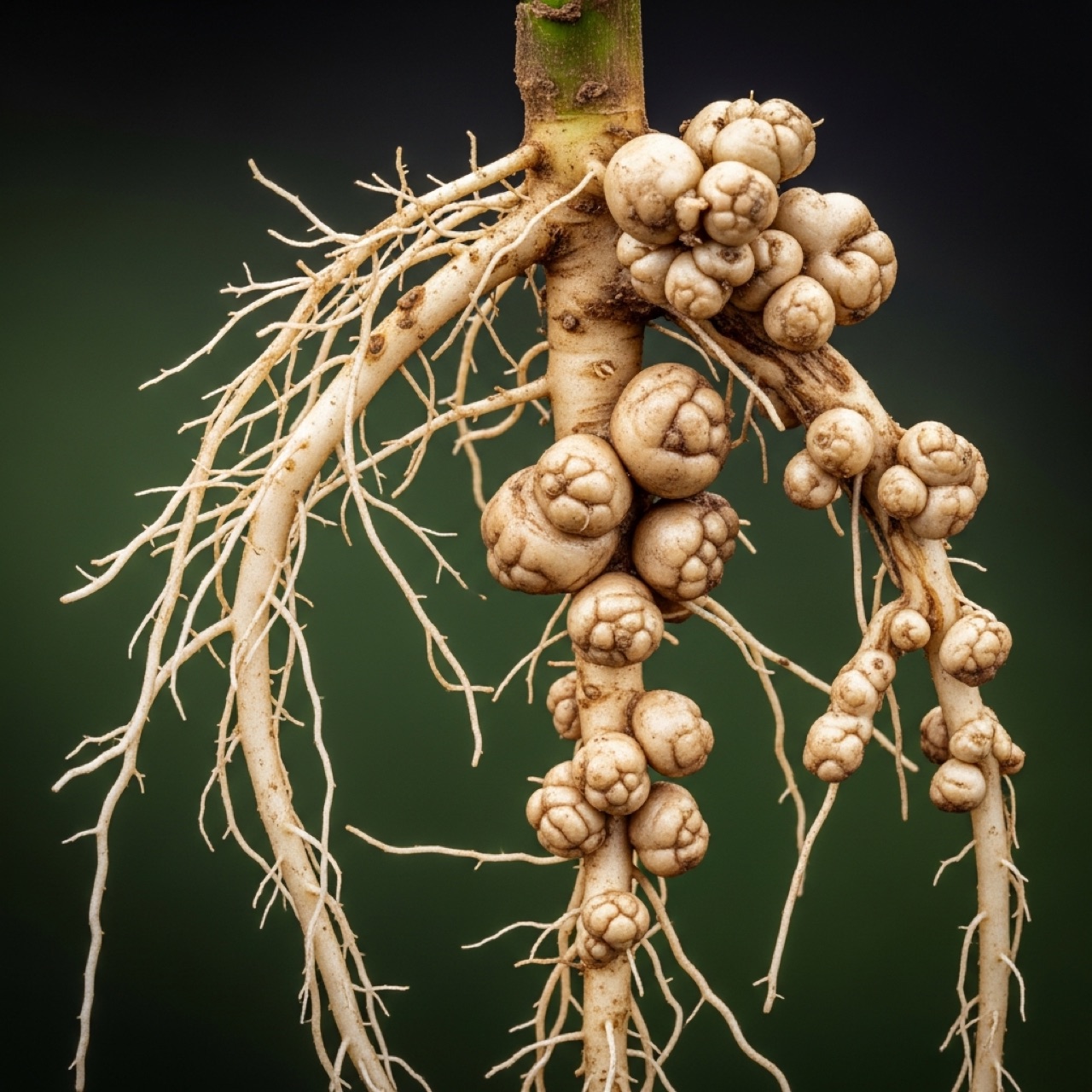
Root-knot nematodes (Meloidogyne species) create galls on the root system that block nutrient and water uptake. In Hawaii's warm volcanic soils, nematode populations can build rapidly. The standard commercial defense is the same graft that protects against Fusarium: purple cultivars on yellow passion fruit rootstock, which confers nematode resistance from the root system up.
What this means for your farm: put the collar zone on your scouting checklist. Pull mulch back and look at the base of each vine on a schedule. It takes seconds per plant and it's the single most-neglected inspection in passion fruit.
Fruit flies: the export barrier
Three fruit fly species are established in Hawaii — Oriental fruit fly (Bactrocera dorsalis), Mediterranean fruit fly (Ceratitis capitata), and melon fly (Zeugodacus cucurbitae) — and all attack passion fruit. Beyond the direct crop damage (larval feeding destroys fruit internally), USDA APHIS classifies all three as quarantine pests that restrict mainland fresh-fruit shipments. For a Hawaii grower, fruit fly isn't only a yield problem; it's a market-access problem.
The primary field tool is GF-120 Naturalyte Fruit Fly Bait, a spinosad-based protein bait. The specs that matter: dilute 1:2 to 1:3 with water, apply to the underside of leaves inside the canopy (never to flowers — spinosad is toxic to bees), reapply every 7–14 days, and shorten intervals during rainy periods and as fruit ripens.
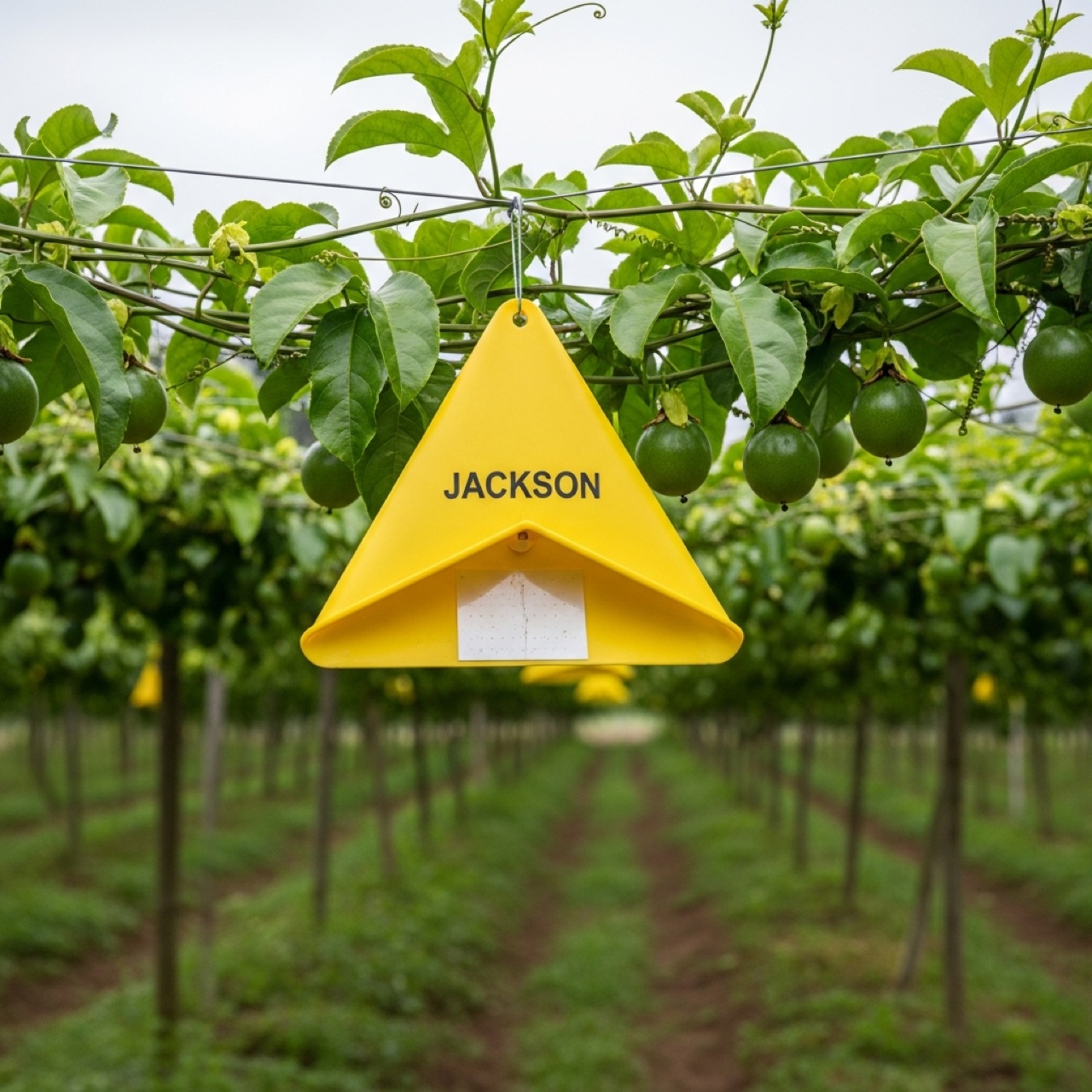
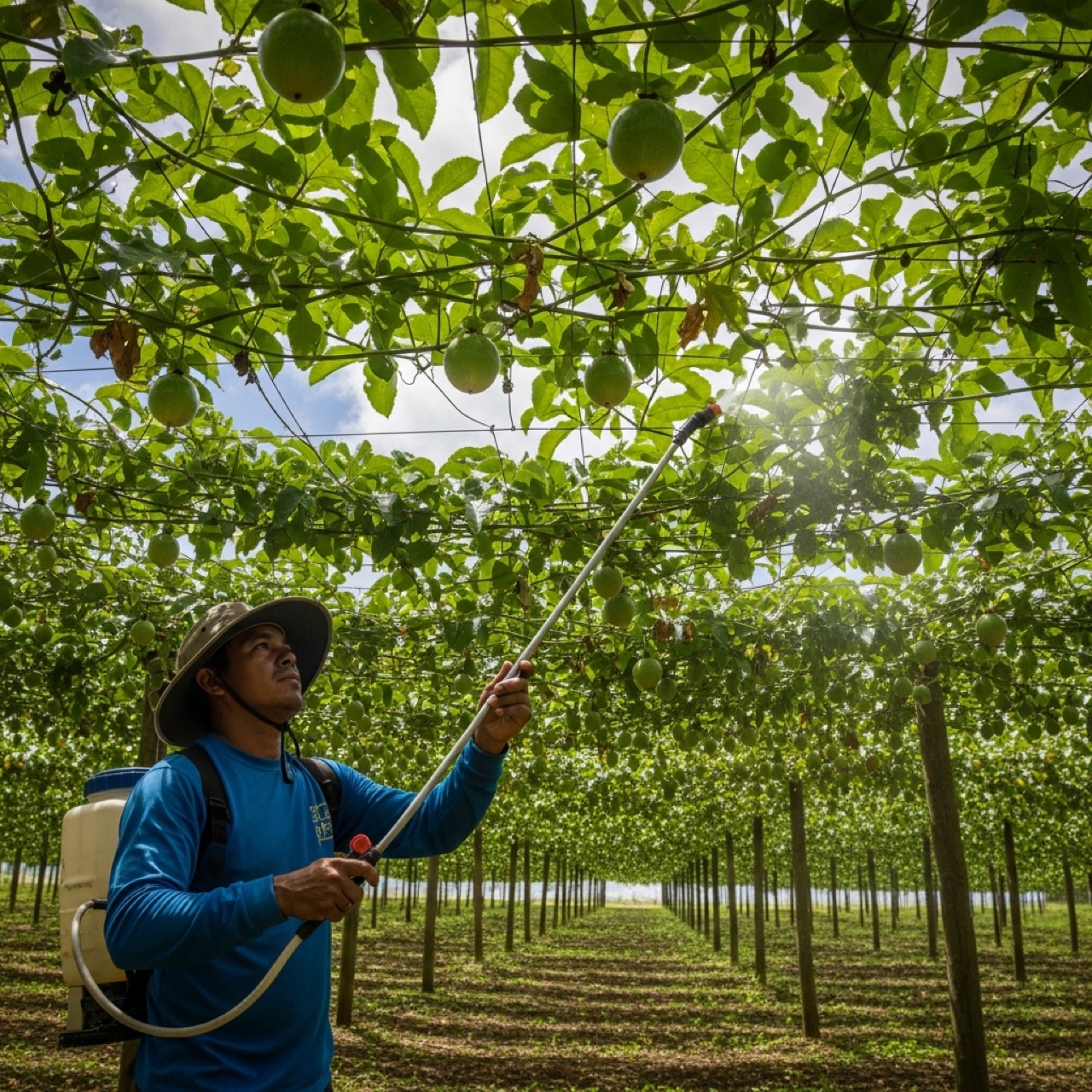
Biological control through parasitoid wasps is well-established in Hawaii. Fopius arisanus (introduced 1949) and Diachasmimorpha longicaudata are the primary agents. Combined with field sanitation — removing all fallen fruit promptly — these create a viable integrated approach that doesn't depend on calendar spraying.
How you actually prevent virus
Since insecticides don't prevent aphid-vectored virus transmission, the prevention program is built from physical and behavioral controls. Three measures carry most of the load.
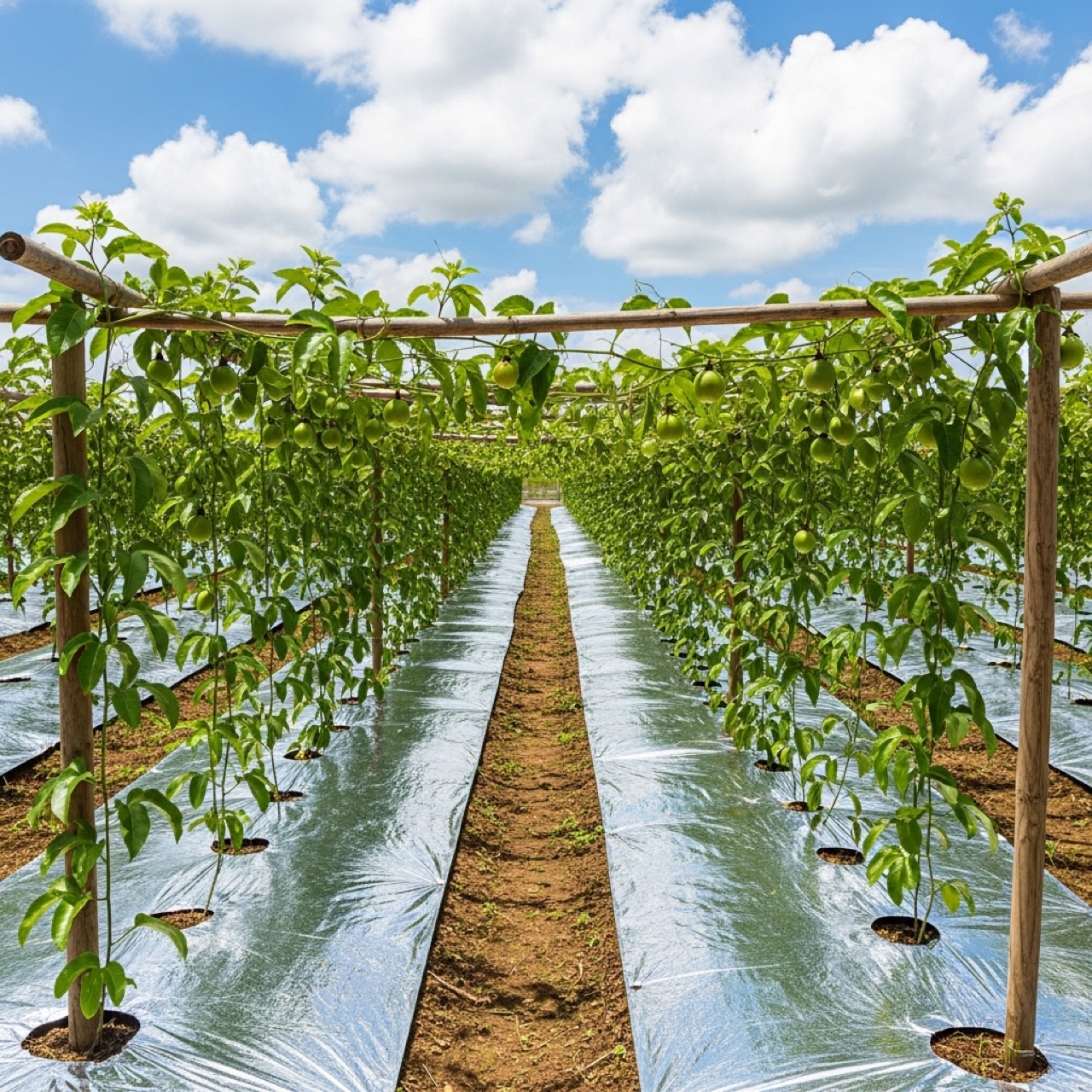
Reflective mulch is the most cost-effective single measure. Silver or aluminum reflective mulch installed as ground cover around plants disorients landing aphids — they navigate by light, and the reflection scrambles their landing cues. Research shows approximately 10× fewer virus-infected plants compared to black mulch or no-mulch plots.
Barrier crops planted around the orchard perimeter intercept viruliferous aphids before they reach the passion fruit. The aphids probe the barrier plants, lose the virus (non-persistent — it's shed after a few probes), and arrive at the crop non-infectious.
Weekly roguing removes virus reservoirs from the orchard before the disease spreads to neighbors. As the Piracicaba data above shows, systematic weekly scouting and removal held CABMV to about 8% after 180 days versus near-total loss without it.
Clean planting material prevents introducing virus at establishment in the first place. Propagation method maps directly to disease risk — and it's a decision you make at the nursery, before anything is in the ground.
| Tissue culture | Lowest | Pathogen-free starting material; clean by design |
| Seed | Low–moderate | Most pathogens aren't seed-transmitted, but verify the source |
| Cuttings | Highest | Transmit every pathogen the mother plant carries through vascular tissue |
Always request ELISA or RT-PCR virus-testing certificates from nurseries. Cuttings are the cheapest way to propagate and the most expensive way to import disease into a clean field.
Tool sterilization is not optional
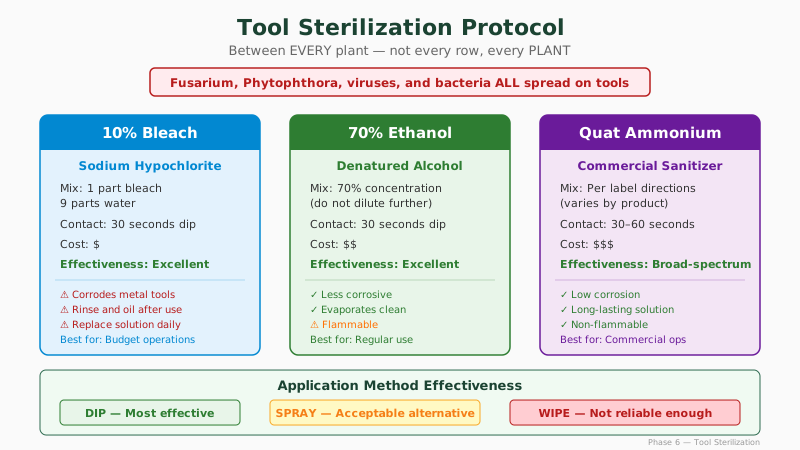
Multiple pathogens — Phytophthora, Fusarium, Xanthomonas, Lasiodiplodia, and all the potyviruses — spread through contaminated pruning tools. Sterilize between every plant. Not every row. Every plant. A single contaminated cut can seed the next vine with whatever the last one was carrying.
| 10% bleach solution | Cheap | Effective, but corrodes metal over time |
| 70% ethanol | Moderate | Less corrosive, more expensive |
| Quaternary ammonium | Moderate | Low corrosion, broad-spectrum |
Dipping tools is most effective; spraying is acceptable; wiping alone is not reliable enough. And don't forget your feet — Phytophthora zoospores travel on soil stuck to boots, so use separate boots for each field section or dip in disinfectant before entering clean areas.
The IPM bottom line
Calendar spraying with broad-spectrum insecticides is not a pest management strategy — it's a way to kill your pollinators, promote resistance, and run up costs while solving nothing. Real passion fruit IPM is a sequence: monitor first (traps, scouting, soil testing), identify the actual pest, determine whether the population exceeds an economic threshold, then apply the least-toxic effective control.
For organic operations, the toolbox includes spinosad, Bt, neem, insecticidal soap, horticultural oil, kaolin clay, and biological control agents — all OMRI-approved. And above everything else: protect your carpenter bees. They're your primary pollinators, and every broad-spectrum spray during flowering is a direct hit on your own fruit set.
To put the whole threat landscape in perspective — not every problem is a planting-killer, and knowing which is which is how you spend your time and money wisely:
| Fusarium wilt | 10 | Disease |
| Viral woodiness (CABMV/PWV) | 9 | Disease |
| Phytophthora crown rot | 8 | Disease |
| Collar rot complex | 6 | Disease |
| Fruit fly (Oriental) | 7 | Pest |
| Root-knot nematode | 5 | Pest |
| Aphids (as virus vector) | 8 | Pest |
| Aphids (direct feeding) | 3 | Pest |
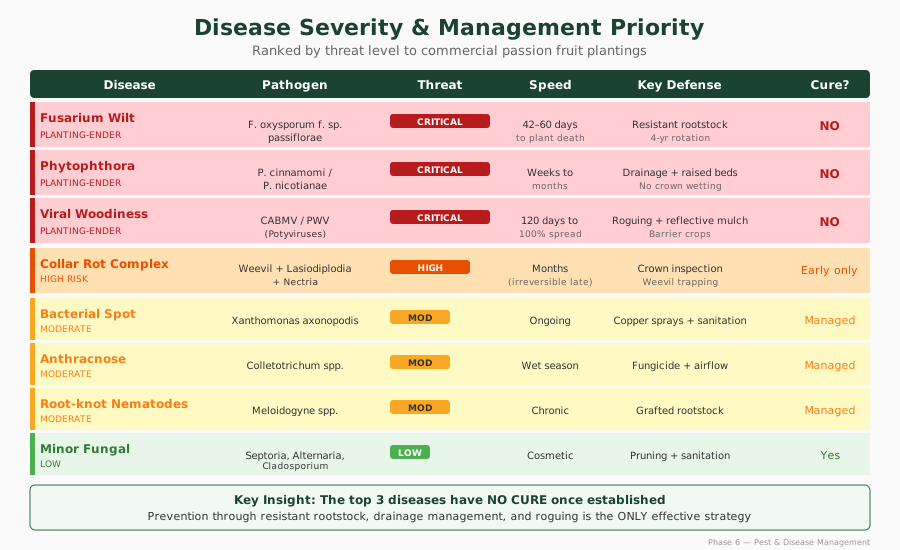
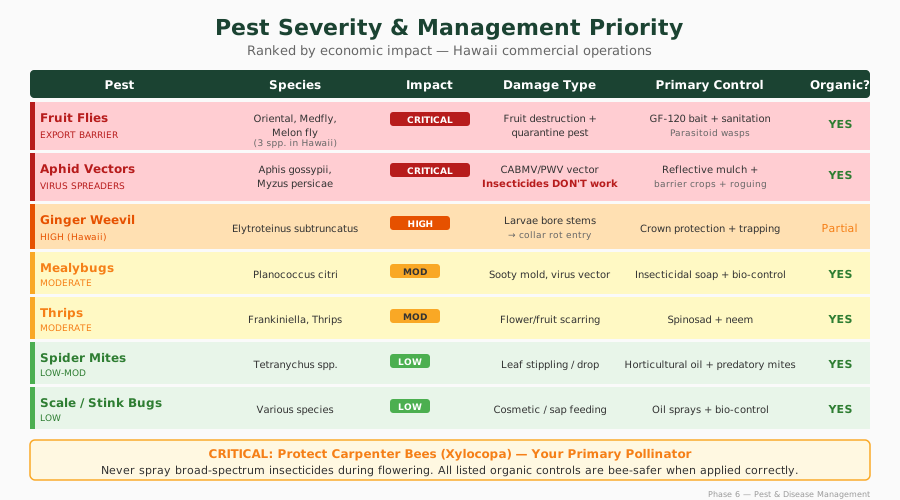
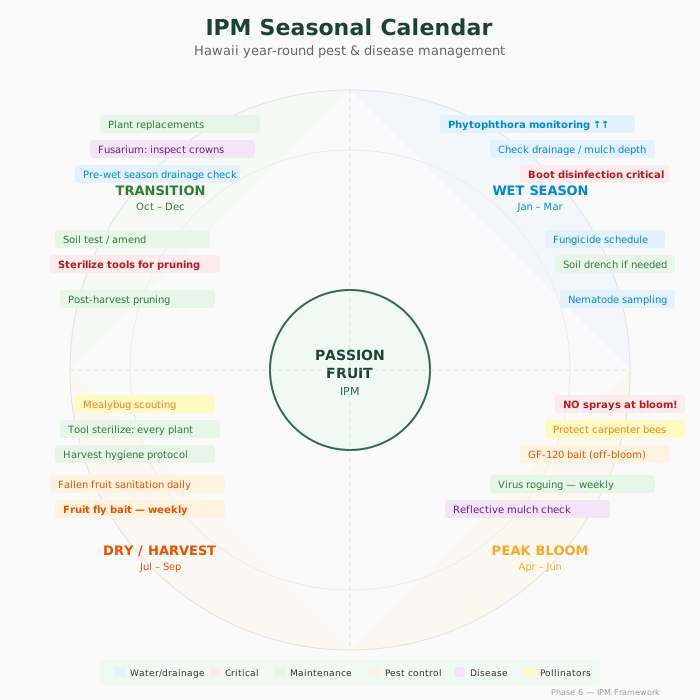
A well-run IPM program isn't a calendar; it's a calendar of decisions — when to scout, when to bait, when to rogue, when to leave well enough alone. The wheel below is how those decisions stack up across a Hawaii growing year.
Where this leaves you
The vines you lose will mostly be lost to decisions you made — or didn't make — before there was anything visible to react to. Choose Fusarium-resistant rootstock before you order plants. Fix drainage before you dig. Source clean material and lay reflective mulch before the aphids arrive. Sterilize between every cut, every time. Scout the collar zone nobody scouts. And when fruit fly pressure builds, reach for bait and sanitation before you reach for a broad-spectrum spray that takes your pollinators down with it.
None of this is exotic. It's just front-loaded — which is exactly why it gets skipped, and exactly why most plantings lose vines they didn't have to.
Sources
- University of Hawaii CTAHR Extension — passion fruit disease and IPM publications
- USDA ARS — fruit fly biological control program, Hawaii
- USDA APHIS — quarantine pest classifications and fresh-fruit shipping restrictions
- UF/IFAS Extension — passion fruit production and disease management, Florida
- EMBRAPA Cerrados (Brazil) — Fusarium-resistant rootstock and P. mucronata genotype screening
- ESALQ-USP, Piracicaba — roguing efficacy for CABMV control in passion fruit
New articles every other Wednesday
Get each new piece in your inbox. No spam, unsubscribe anytime.