Carpenter Bees and Lilikoi — How to Get Pollination for Free
By Brian
Hand-pollinating an acre of yellow passion fruit costs $900 to $1,500 a year in Hawaii — every year, for the life of the planting. Carpenter bees do exactly the same job for free. The entire difference between those two numbers is whether you know how to get bees to show up and stay.
Most growers who fail with yellow lilikoi don't fail because of disease, weather, or soil. They fail because their flowers never got properly pollinated. The passion fruit flower is built for one specific kind of insect, and if that insect isn't around — or if your vines are all genetic clones — you get a field of healthy vines and almost no fruit.
This article is the pollination playbook: the biology you actually need, why honeybees are the wrong tool, the one fact almost every grower misses, and the three ways to solve it ranked by cost.
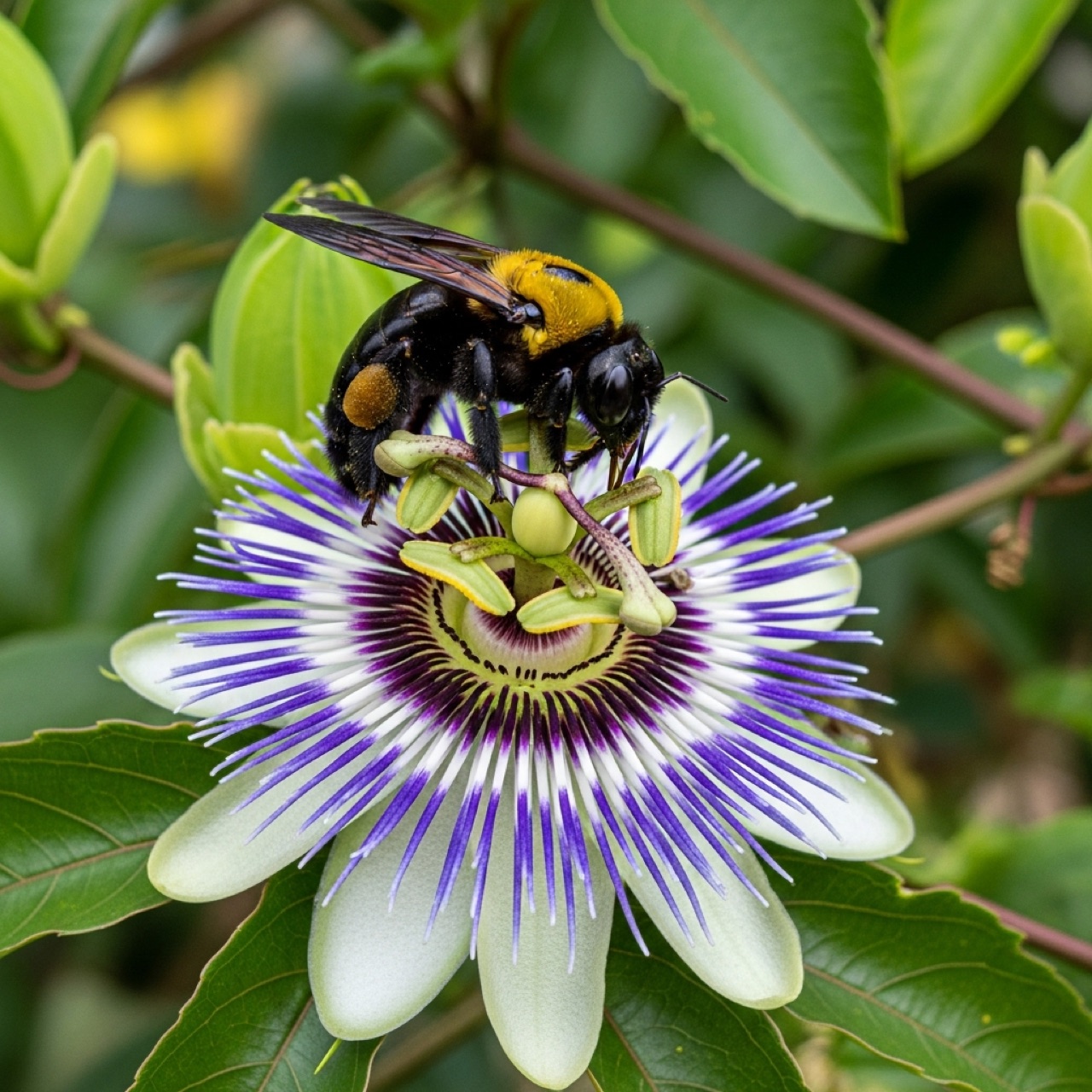
The flower is built for a big bee
The passion fruit flower has an unusual central column — the androgynophore — that holds all five pollen-producing anthers and three pollen-receiving stigmas at different heights. The spacing is deliberate: it's wide enough that a small insect can crawl in, drink nectar, and leave without ever touching both the anthers and the stigmas. No pollen transfer, no fruit.
The timing is just as specific:
- Flowers open mid-morning to noon
- Anthers rotate 180° downward within about an hour of opening, exposing pollen
- Stigmas curve down over the next few hours into the contact zone
- The productive pollination window is roughly the first 4–6 hours, and it has to happen the same day the flower opens
This is a flower designed for a large-bodied pollinator visiting around midday. Build your whole pollination strategy around that and you're working with the plant. Ignore it and you're working against it.
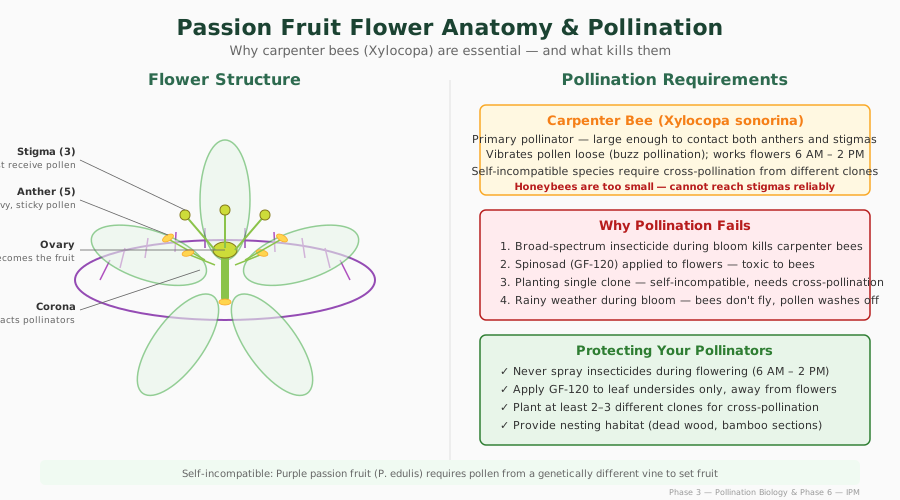
Why carpenter bees, not honeybees
This surprises almost everyone: honeybees are the wrong pollinator for passion fruit.
A honeybee is about 13mm long. That's too small to bridge the gap between the anthers and the stigmas on the androgynophore in a single visit. It works the flower for nectar and leaves without depositing pollen where it counts. A carpenter bee (Xylocopa) is about 20mm — big enough to contact both at once — and it buzz-pollinates, vibrating to shake pollen loose. Honeybees can't do that.
| Body length | ~20mm | ~13mm |
| Spans the androgynophore? | Yes — contacts anthers + stigmas | No — too small |
| Buzz pollination | Yes | No |
| Fruit set rate | 3–5× better | Baseline (poor) |
| Fruit quality | Larger, sweeter, more seeds | Smaller, fewer seeds |
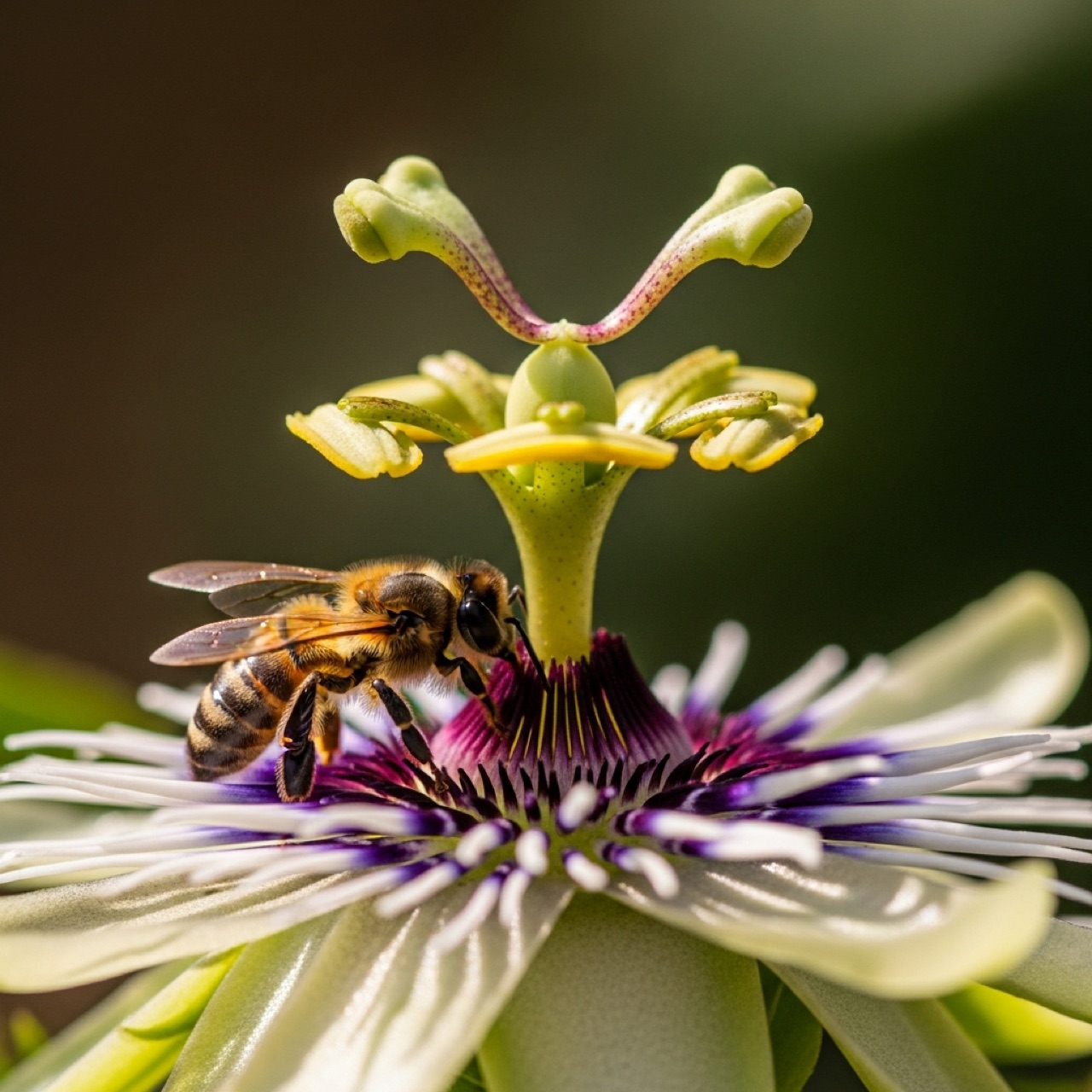
In Hawaii, the bee that matters is Xylocopa sonorina, the Hawaiian carpenter bee. Brazilian field research found that carpenter-bee-pollinated fruit was actually larger, sweeter, and higher in seed count than hand-pollinated fruit. The bees don't just replace the labor — they do a better job.
The self-incompatibility barrier (the clone trap)
Even with perfect bees, yellow passion fruit has a second requirement: genetic diversity. Yellow uses a sporophytic self-incompatibility system — a vine's pollen can't fertilize its own flowers, or the flowers of any genetically identical vine. The plant recognizes its own genetic signature and shuts fertilization down at the pollen-tube stage.
The practical fallout:
- A planting from cuttings of a single mother plant produces zero fruit, no matter how many bees you have
- You need a minimum of 2–3 genetically distinct, seed-sourced lines
- Those lines have to be interplanted within bee flight range of each other
- Hand pollination has to move pollen between compatible lines, not just between flowers
Purple passion fruit is generally self-compatible and sidesteps this entirely. If pollinator management isn't realistic for your site, that alone can justify choosing purple.
The fact almost everyone misses: the pollen gap
Here's the under-known one. Getting carpenter bees to visit is one thing. Getting a resident population to stay is another — and the difference comes down to food.
Passion fruit flowers are generous with nectar, but a midday-only bloom on a single crop doesn't sustain a carpenter bee population on its own. There's a gap in the bees' forage — particularly pollen — across the day and the season. If you don't fill that gap, the bees you attract drift off to better-fed territory, and your fruit set sags right when you need it.
The fix is cheap and almost nobody does it: plant a pollen garden. Lantana, blue porterweed, and Mexican sunflower are carpenter bee magnets, and crucially they keep forage available around that noon passion fruit window. You're not just attracting bees — you're feeding them well enough that they treat your farm as home.
Strategy 1: build carpenter bee habitat
Cost: $500–$1,000/acre setup. Timeline: 12–24 months to establish a resident population.
Xylocopa sonorina nests in dead wood — dry, unpainted, untreated, at least 2 inches in diameter. You're creating two things: places to nest and things to eat.
- Position wooden posts, dead tree sections, or commercial carpenter bee houses within 200m of the vines
- Plant the pollen garden (lantana, blue porterweed, Mexican sunflower) to cover the noon window
- Don't spray pesticides during peak foraging, 10am–2pm
- Protect any existing nesting wood when you're clearing or prepping the site
The tradeoff is time. Habitat is a background investment that takes a year or two to pay off, so a new planting can't rely on it alone at first — you bridge with hand pollination while the bee population builds.
A note on relocating bees
If you already have carpenter bees nesting in old wood elsewhere on the property, the move that works is relocating the nesting wood with the brood inside — not trying to catch adults. Adult carpenter bees are strongly site-faithful: capture and release them somewhere new and they'll fly back to where they came from. The developing brood, by contrast, emerges at wherever you've placed the gallery and imprints on that location. Move the block, leave it near the new habitat, and let the next generation adopt the spot. (This is general carpenter bee practice — test it small before counting on it.)
Strategy 2: hand pollination (the cost to beat)
Cost: $900–$1,500/acre/year in Hawaii, and rising with the wage rate.
Workers collect pollen from one genetic line and brush it onto the stigmas of another during the noon-to-2pm window. It's proven, effective, and fully under your control — which is exactly why it's the baseline every other option gets measured against.
| Flowers/acre/day (peak) | 200–400 |
| Flowers/worker/hour | 80–120 |
| Hours/acre/day | 2–5 |
| Hawaii wage rate (2025 AEWR) | $20.08/hr |
| Daily cost/acre | $40–$100 |
| Annual cost/acre (120-day season) | $900–$1,500 |
For a new yellow operation, hand pollination during Years 1–2 isn't optional — it's how you get a crop while the bees establish. The goal is to graduate off it as habitat matures, not to run it forever.
Strategy 3: mechanical (electrostatic) pollination
Capital: $15,000–$50,000. Breakeven: 3–4 years on a 5-acre Hawaii operation.
Electrostatic spray systems — already proven in cherries, apples, and almonds — suspend pollen in liquid and give it a positive charge; the grounded, negatively charged stigmas pull it in with little waste. Washington State University trials showed 15% higher fruit set in cherries; apple trials showed 56–75% improvement over natural pollination.
Passion fruit is unusually well-suited to this: its pollen is heavy and sticky (useless for wind, ideal for electrostatic delivery), its noon bloom is predictable enough to schedule, and trellis rows give a boom system clean geometry to work with. No system is marketed specifically for passion fruit yet, but the underlying technology transfers directly.
| Annual hand cost (5 acres) | $7,500–$15,000/yr |
| Mechanical system capital | $25,000 (mid-range) |
| Annual operating cost | $2,000–$3,000 |
| Annual savings vs hand | $5,000–$12,000/yr |
| Payback period | 2–4 years |
This is a Year-3-and-beyond decision, and only once you're past 3–5 acres. Below that, the capital doesn't pencil out against habitat plus hand pollination.
The phased plan
For a new operation, the strategies aren't either/or — they stack over time.
| A — Planting | Day 1 | Plant 2–3 distinct seed lines; install nesting wood + pollen garden alongside the trellis |
| B — Establishment | Year 1–2 | Hand pollinate while bees build; record fruit set by line and bee activity by site |
| C — Scale | Year 3+ | Evaluate mechanical above 3–5 acres; reduce hand pollination as bees take over; keep habitat as insurance |
Bottom line
If you're growing yellow lilikoi, pollination is the thing that will make or break you, and it's almost entirely within your control. Plant genetic diversity so the flowers can set fruit. Build nesting habitat and a pollen garden so carpenter bees show up and stay. Bridge with hand pollination for the first couple of years. And only reach for a mechanical system once your acreage is big enough to justify the capital.
Do that and the $900-an-acre annual bill quietly disappears — replaced by a resident workforce that does the job better than your hands could, for free.
Sources
- Junqueira & Augusto (2017) — carpenter bee pollination trials, Brazil
- Washington State University CPAAS — electrostatic pollination research (cherry & apple trials)
- OnTarget Spray Systems; Edete Precision Technologies — commercial electrostatic pollination systems
- University of Hawaii CTAHR — Xylocopa sonorina and passion fruit pollination guidance
- US DOL / USDA — 2025 Hawaii Adverse Effect Wage Rate (AEWR)
New articles every other Wednesday
Get each new piece in your inbox. No spam, unsubscribe anytime.