The Trellis Decision That Locks In Your Farm's Economics for a Decade
By Brian
The trellis you build in Year 1 sets your yield ceiling, your harvest labor cost, your fruit sunburn rate, and your wind exposure for the entire productive life of the planting — 5 to 10 years. Most growers give it one line in the budget and a quick decision. That's a mistake that compounds.
Here's the short version: across the four common systems, a better trellis is one of the highest-return capital investments in passion fruit farming. Over 10 years at $6.50/lb, a vertical fence grosses roughly $234,000 per acre and an A-frame grosses about $439,000 — a $205,000 gap that recovers the extra $4,500–8,000 in construction cost by Year 2 or 3. The only real limits are how much capital you have in Year 1 and whether you can sell the extra volume.
Why trellis choice matters more than it looks
Before comparing systems, get clear on what you're optimizing for. Every dimension — wire height, row spacing, frame angle — controls how much of the canopy receives productive light. Light density drives flower density, flower density drives fruit set, and fruit set drives the only number that matters at the end of the season.
Internal shading is yield lost permanently, until you prune it back out. That's why the same vine, on the same soil, in the same climate, can yield more than twice as much on one trellis as on another. The plant isn't different. The light geometry is.
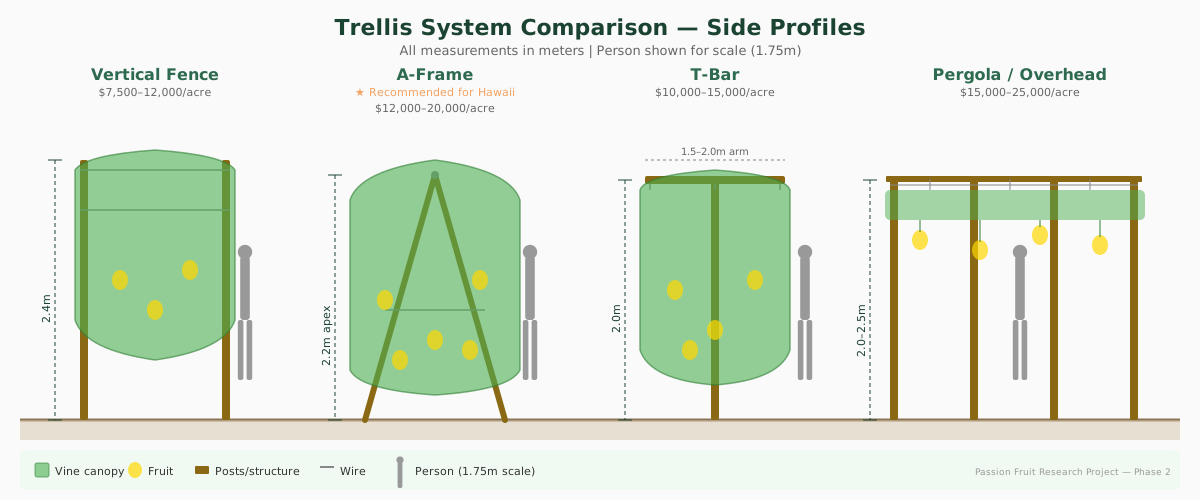
The four systems at a glance
The three-dimensional systems — A-frame and pergola — protect fruit from sun and wind and put more lit canopy in the air. The flat systems — vertical fence and T-trellis — are cheaper and simpler but leave fruit exposed and cap yield lower.
1. Vertical fence
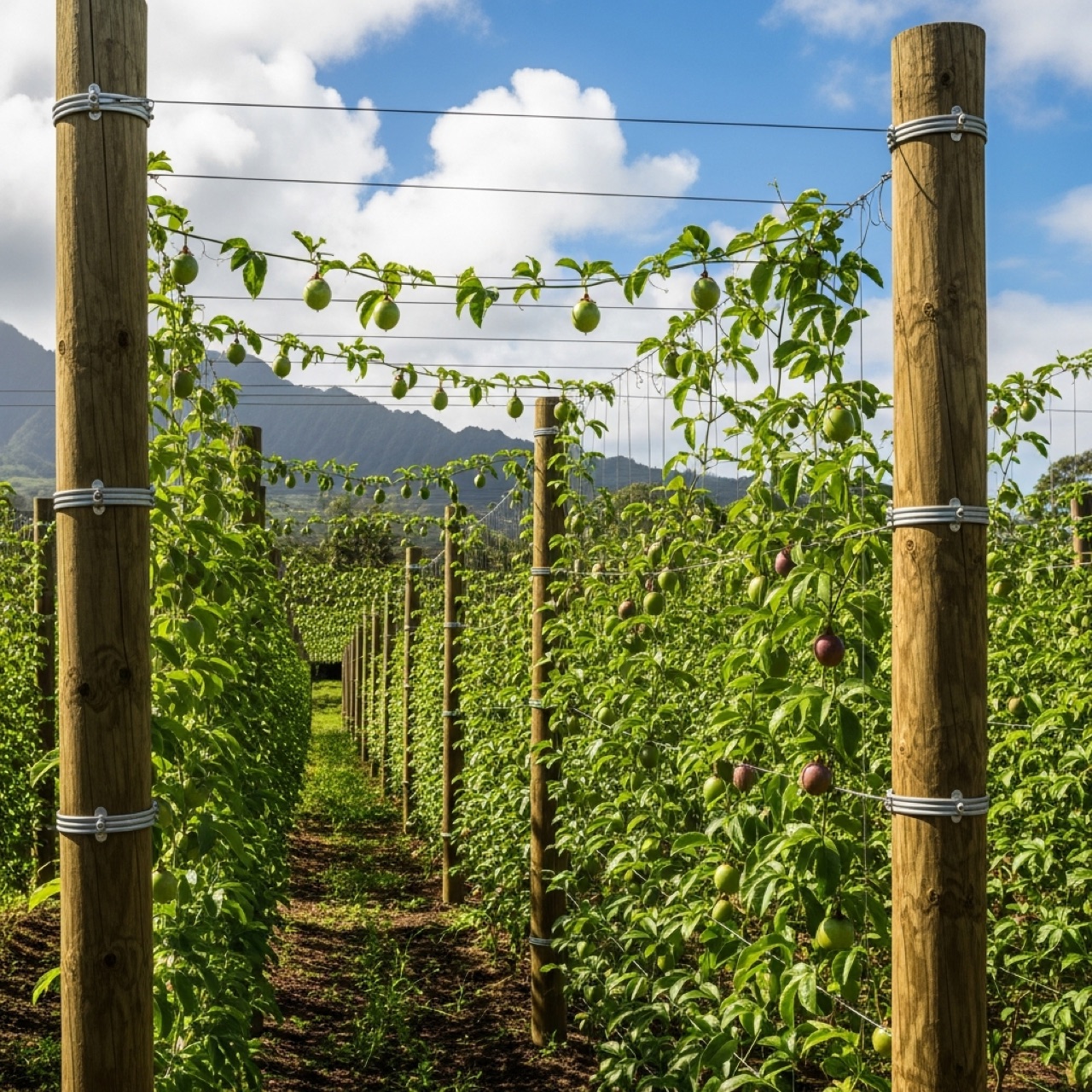
The simplest system. Posts at 6 m (20 ft) intervals, three horizontal wires, vines trained up to the top wire and along it in both directions — a flat curtain.
| Post height above ground | 2.0 m (6.5 ft) |
| Post spacing along row | 6.0 m (20 ft) |
| Row spacing | 2.0–3.0 m (6.5–10 ft) |
| Wire gauge | 12–14 gauge galvanized |
| Number of wires | 3 horizontal |
| End post anchoring | Deadman anchors or H-braces |
| Cost per 100 linear ft | $400–650 |
| Cost per acre (installed) | $7,500–12,000 |
Where it works: small operations under 2 acres, first-year growers managing capital, sites where low upfront cost is the binding constraint. Where it doesn't: intense tropical sun — fruit hangs exposed and sunburns, and in the Hawaii lowlands sunburned yellow lilikoi is commercially worthless. Wind exposure is higher than the 3D systems, and yield per acre is the lowest of the four.
2. A-frame
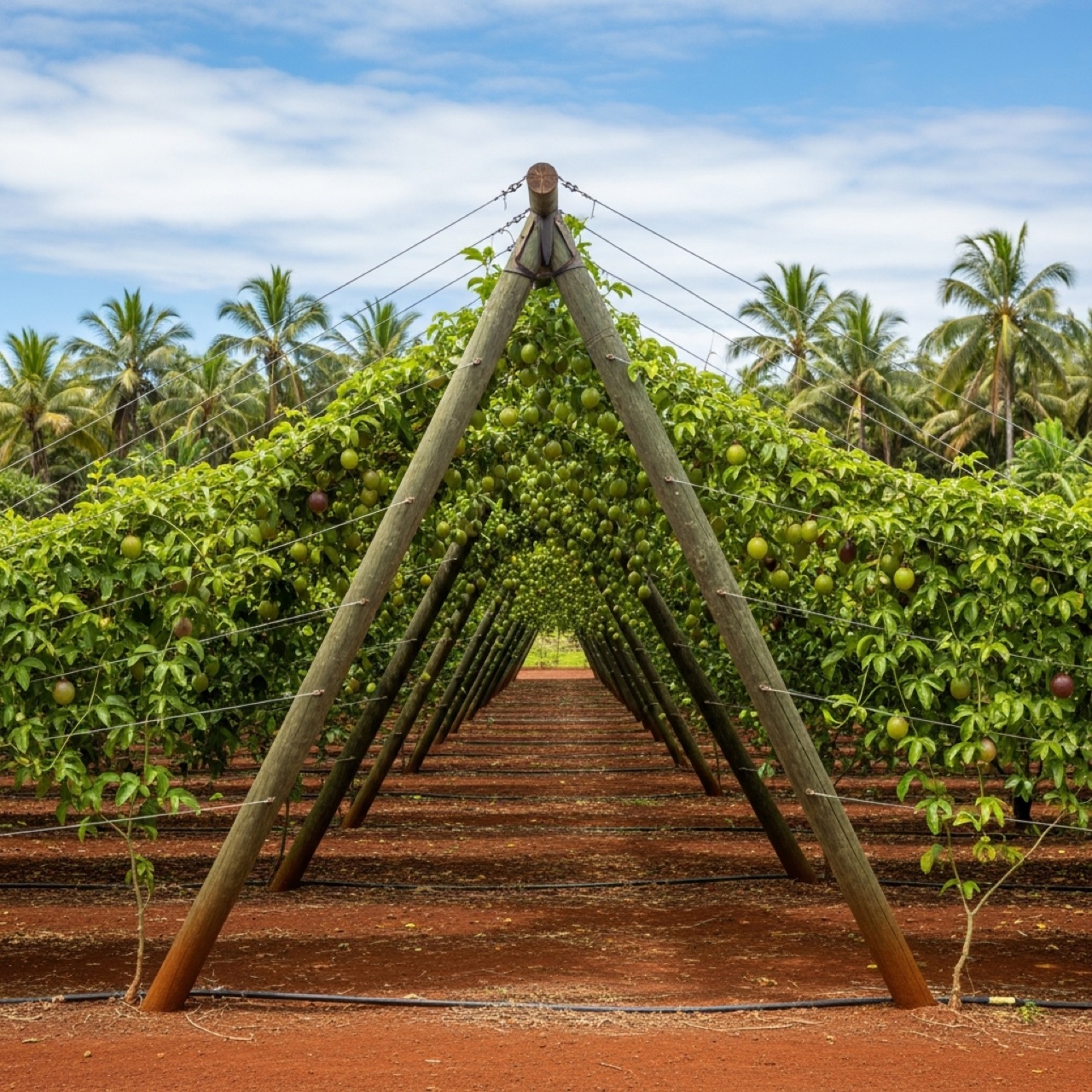
Triangular frames at 6 m intervals form an inverted-V canopy. Vines climb both sides and fruit hangs inside — shaded, wind-protected, and reachable at harvest without bending. This is the dominant commercial system in Australia, New Zealand, and Brazil, and the recommended primary system for most Hawaii operations.
| Frame height at apex | 2.0–2.4 m (6.5–8 ft) |
| Frame width at base | 2.0–2.5 m (6.5–8.2 ft) |
| Frame spacing along row | 6.0 m (20 ft) |
| Row spacing | 3.5 m (11.5 ft) |
| Wires per side | 4–6 wires, 500 mm spacing |
| Wire gauge | 12 gauge galvanized (HDG recommended) |
| Cost per 100 linear ft | $600–950 |
| Cost per acre (installed) | $12,000–20,000 |
| Frame height at apex | 2.2 m (7.2 ft) |
| Frame base width | 2.2 m (7.2 ft) |
| Frame spacing along row | 6 m (20 ft) |
| Row spacing | 3.5 m (11.5 ft) |
| Plant spacing (in-row) | 3 m (10 ft) |
| Plant density | ~420 plants/acre |
| Posts | HDG steel pipe 2" dia (or PT 4×4 for inland sites) |
| Wire | 12 gauge HDG, 4 wires per side |
| Anchoring | H-brace + deadman at all row ends |
| Row orientation | Perpendicular to prevailing tradewinds |
Where it works: medium-to-large commercial operations (2–10 acres), tropical climates where sunburn is a real risk (most of lowland Hawaii), and any operation prioritizing long-term labor efficiency and fruit quality. Where it doesn't: very small plots where the cost premium over a fence isn't recovered in yield, or operations with severe Year-1 budget constraints — for which there's a phased path below.
Australian and New Zealand growers have standardized on the A-frame, with Passion Fruit Australia's best-practice guidelines specifying 2.2 m apex height and 3.5 m row spacing — the same configuration UH CTAHR trial data confirms for Hawaii.
3. Pergola
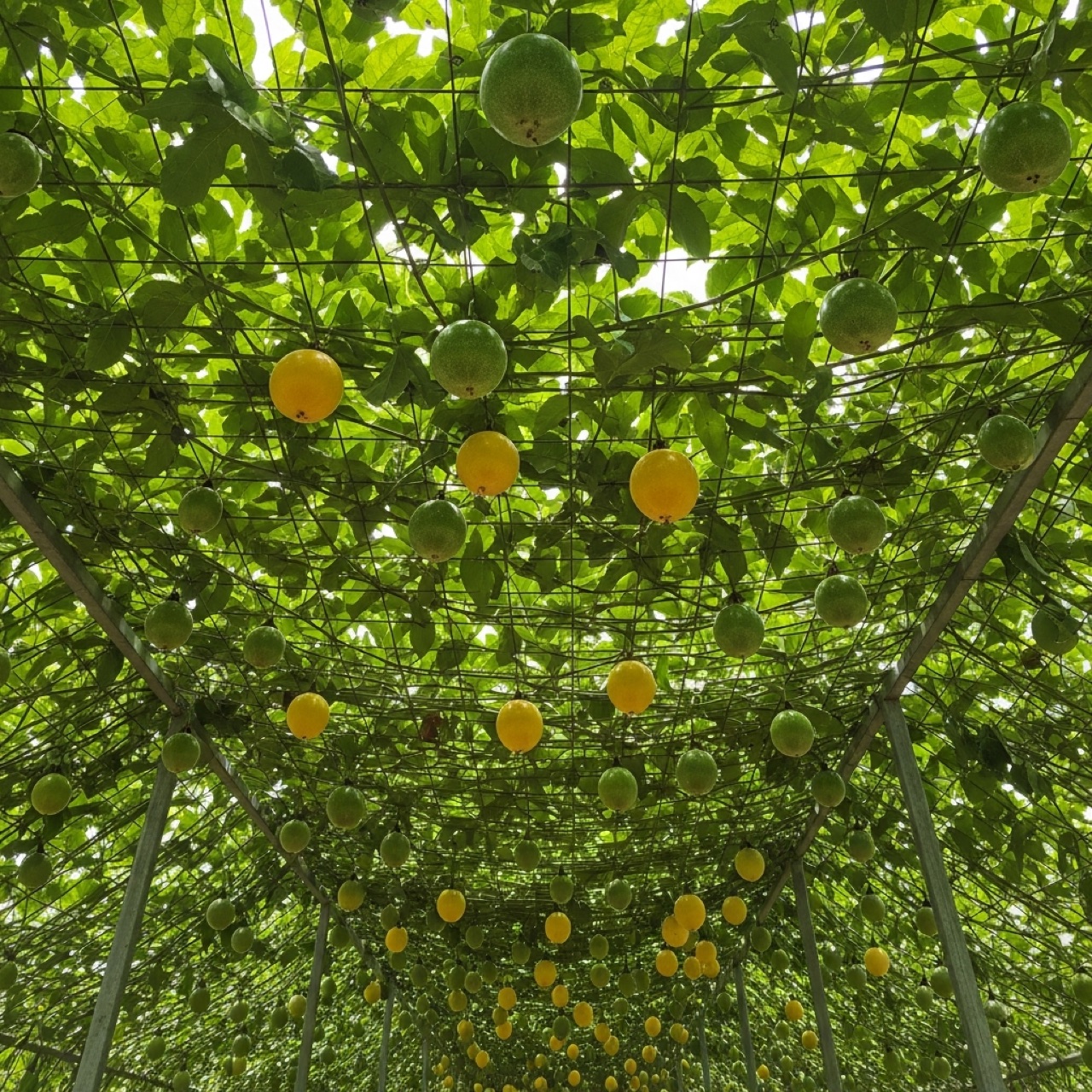
An overhead horizontal canopy on tall posts. Vines climb vertical supports and spread across an overhead wire grid; all fruit hangs down beneath the canopy, fully shaded and harvested standing upright.
| Post height | 2.5–3.0 m (8–10 ft) |
| Post spacing | 4.0–6.0 m grid |
| Wire grid | Crosshatch, 500–700 mm spacing |
| Row spacing | 4.0–5.0 m (13–16 ft) |
| Wire gauge | 11–12 gauge HDG |
| Cost per 100 linear ft | $700–1,050 |
| Cost per acre (installed) | $15,000–25,000 |
Where it works: large operations (10+ acres) in intense tropical sun where fruit protection is critical — Brazil's highest-yielding commercial blocks use pergolas. When labor cost per pound harvested is the metric you're optimizing, standing-height harvest under a full canopy is the most ergonomic configuration there is. Where it doesn't: smaller operations where the capital cost isn't recovered fast enough, and any site where you can't stay on top of canopy density — a dense pergola cuts airflow and raises fungal disease pressure.
4. T-trellis (Kniffin system)
Vertical posts with a horizontal cross-arm at the top, forming a T, with four wires along the cross-arms. Common in India and referenced in some US extension materials. Performs much like a vertical fence but with a slightly wider canopy. Cross-arm materials add roughly $300–550 per 100 linear feet over a fence; installed cost is $8,000–13,500/acre. It's the system most Florida (UF/IFAS) extension publications are built around, and what many Phase 4 financial models assume.
Side-by-side cost comparison
| Vertical Fence | $4,500–7,500 | $7,500–12,000 | $19–30 |
| T-Trellis | $5,000–8,500 | $8,000–13,500 | $20–34 |
| A-Frame | $8,000–12,000 | $12,000–20,000 | $30–50 |
| Pergola | $10,000–15,000 | $15,000–25,000 | $38–63 |
Which system has the best 10-year ROI?
Upfront cost is the wrong question. The right one is what each system earns and costs over its productive life. The assumptions below are conservative Hawaii estimates from Phase 4 research — yellow lilikoi, leeward Big Island, farm-gate pricing:
- Farm-gate price: $6.50/lb (blended farmers market + wholesale)
- Hand-pollination cost: $1,500/acre/year in the years it's required
- Annual operating cost excluding trellis: $12,000/acre/year at maturity
- Ramp: Year 1 yields 40% of mature, Year 2 yields 75%, Years 3–10 full production
| Vertical Fence | 4,000 | UF/IFAS Florida baseline (conservative for Hawaii) |
| T-Trellis | 5,000 | UF/IFAS + modest gain for wider canopy |
| A-Frame | 7,500 | Commercial Australia/NZ data, Hawaii-adjusted |
| Pergola | 9,500 | Brazil intensive benchmark, Hawaii-adjusted |
Run those yields through the 10-year ramp and the gap compounds into real money:
| Vertical Fence | 4,000 lbs | ~$234,000 | — |
| T-Trellis | 5,000 lbs | ~$293,000 | +$59,000 |
| A-Frame | 7,500 lbs | ~$439,000 | +$205,000 |
| Pergola | 9,500 lbs | ~$556,000 | +$322,000 |
The incremental construction cost of a better system is recovered fast: the T-trellis's roughly $6,000 premium, the A-frame's $4,500–8,000, and the pergola's $7,500–13,000 are all earned back by Year 2 or 3 through higher yield. On a per-acre basis, upgrading the trellis is one of the highest-ROI capital moves in passion fruit farming.
What this means for your farm: if you can fund it and you have buyers, the A-frame is the default for most Hawaii yellow lilikoi. The yield premium pays for the steel inside two seasons, and you get sun protection and standing-height harvest as a bonus. Go pergola only when you're at scale (10+ acres) with the market to absorb 9,500 lbs/acre. Stay on a fence only if Year-1 cash genuinely forces it — and if so, build it on A-frame geometry so the upgrade is cheap.
The decision matrix
| Construction cost | Lowest | Low–medium | Medium | Highest |
| Yield per acre | Lower | Medium | Higher | Highest |
| Fruit sunburn risk | High | High | Low | Very low |
| Harvest ergonomics | Fair | Fair | Good | Best |
| Wind resistance | Moderate | Moderate | Better | Best |
| Skill to build | Low | Low | Medium | High |
| Disease risk | Low | Low | Low–medium | Medium |
| Best for scale | Under 2 acres | 1–3 acres | 2–10 acres | 10+ acres |
| Hawaii recommendation | Entry-level only | Acceptable | Primary rec. | Large-scale |
Hawaii-specific design requirements
Wind engineering
Hawaii's tradewinds (10–20 mph typical, gusts higher) impose structural requirements mainland designs often skip:
- Post embedment: minimum 30% of post length in ground (a 2.4 m post = 0.72 m embedded minimum)
- End post bracing: H-braces or deadman anchors at all row ends — not optional
- Wire tensioning: high-tensile wire on windward sites, for less sag under wind load
- Row orientation: perpendicular to prevailing tradewinds where topography allows
- Windbreaks: Leucaena, Moringa, or Napier grass hedgerows on the windward side — and these double as carpenter bee forage habitat, which the pollination work depends on
For storm planning: well-anchored A-frames generally survive Category 1–2 with minor damage; Category 3+ causes partial or total loss across all systems. Design for fast post-storm triage with modular, standardized components.
Salt-air corrosion (coastal sites)
Within 1–2 miles of the ocean, standard galvanized components degrade faster than inland equivalents.
| HDG steel posts | 15–20 years | 20–30 years |
| PT wood posts | 10–15 years | 15–20 years |
| 12 gauge HDG wire | 10–15 years | 20–25 years |
| Wire tensioners / hardware | 8–12 years | 10–15 years |
For coastal sites use hot-dip galvanized — not standard galvanized — on all posts, stainless hardware at clips and tensioners, and cold-galvanizing compound on every cut wire end. Budget wire replacement every 10–12 years as a known capital expense.
Material sourcing in Hawaii
| Pressure-treated lumber (4×4, 4×2) | Heavy galvanized steel pipe and T-posts |
| Basic 14-gauge galvanized wire | High-tensile wire in commercial quantities |
| Concrete | Prefabricated A-frame steel components |
| Local hardwoods (eucalyptus, ohia — limited) | Commercial wire tensioners and strainers |
Get local quotes before committing to a spec. Mainland freight adds 30–50% to steel post prices, and the technically "correct" solution often isn't the economical one here — local hardwood posts from a sawmill can beat imported galvanized steel on cost-per-year-of-service even when the spec sheet disagrees.
Integrating irrigation into trellis design
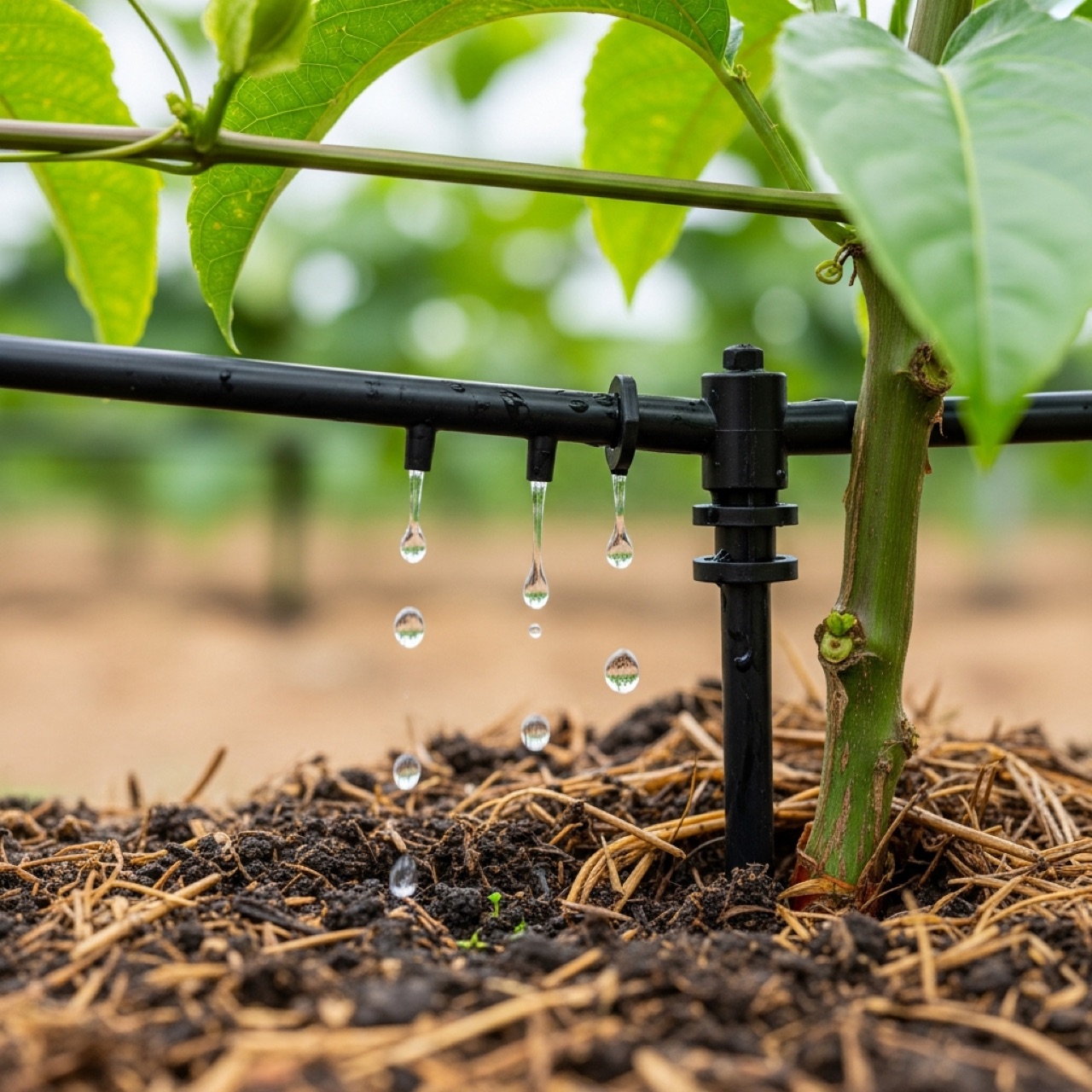
Plan trellis layout and irrigation together — retrofitting is expensive. Row spacing dictates mainline routing; plant spacing dictates emitter placement. Drip is the commercial standard: it delivers water to the root zone without wetting foliage (lower fungal pressure), holds consistent soil moisture, and integrates with fertigation.
Key specs:
- Mainline: along row center, buried 6–12 inches or surface-protected
- Emitters: 2 per plant, 12–18 inches from the stem on each side
- Flow rate: 0.5–1.0 GPH for sandy soils; 0.5 GPH for clay/volcanic soils
- Pressure regulation: at each zone head — passion fruit roots are sensitive to over-irrigation
- Fertigation injector: at the main header for soluble nutrient delivery
Water requirements by stage: establishment (Year 1) runs 1–2 gallons/plant/day until roots set; production (Year 2+) runs 2–4 gallons/plant/day during fruiting. At 3.5 m row spacing (A-frame standard), one mainline per row reaches both sides, and with 3 m in-row spacing the laterals never need to extend more than 1.5 m from the plant — clean geometry that simplifies install and maintenance.
Infrastructure lifespan and replacement planning
| HDG steel posts (inland) | 20–30 years |
| HDG steel posts (coastal) | 15–20 years |
| PT wood posts | 15–20 years |
| 12 gauge HDG wire (inland) | 20–25 years |
| 12 gauge HDG wire (coastal) | 10–15 years |
| Wire tensioners / hardware | 10–15 years |
| Drip tape / emitters | 5–10 years |
| A-frame weld joints (steel) | 15–20 years (inspect annually for corrosion) |
The phased approach for tight Year-1 budgets
If Year-1 cash is the constraint, you don't have to choose between the best system and the only one you can afford. Build toward the A-frame in stages:
- Year 1–2 (entry): install a vertical fence on A-frame geometry — 3.5 m rows, the post spec you'll use for the A-frame later. Capital cost $7,500–10,000/acre. Get vines established, learn the site, build the market.
- Year 3–5 (upgrade): convert to A-frame by adding cross-frame components to the existing posts. Most of the post cost is already sunk; incremental conversion runs $4,000–8,000/acre, covered by Year 2–3 revenue.
- Year 5+ (optimization): evaluate whether volume and market access justify upgrading top blocks to pergola — a data-driven call by then, not a speculative one.
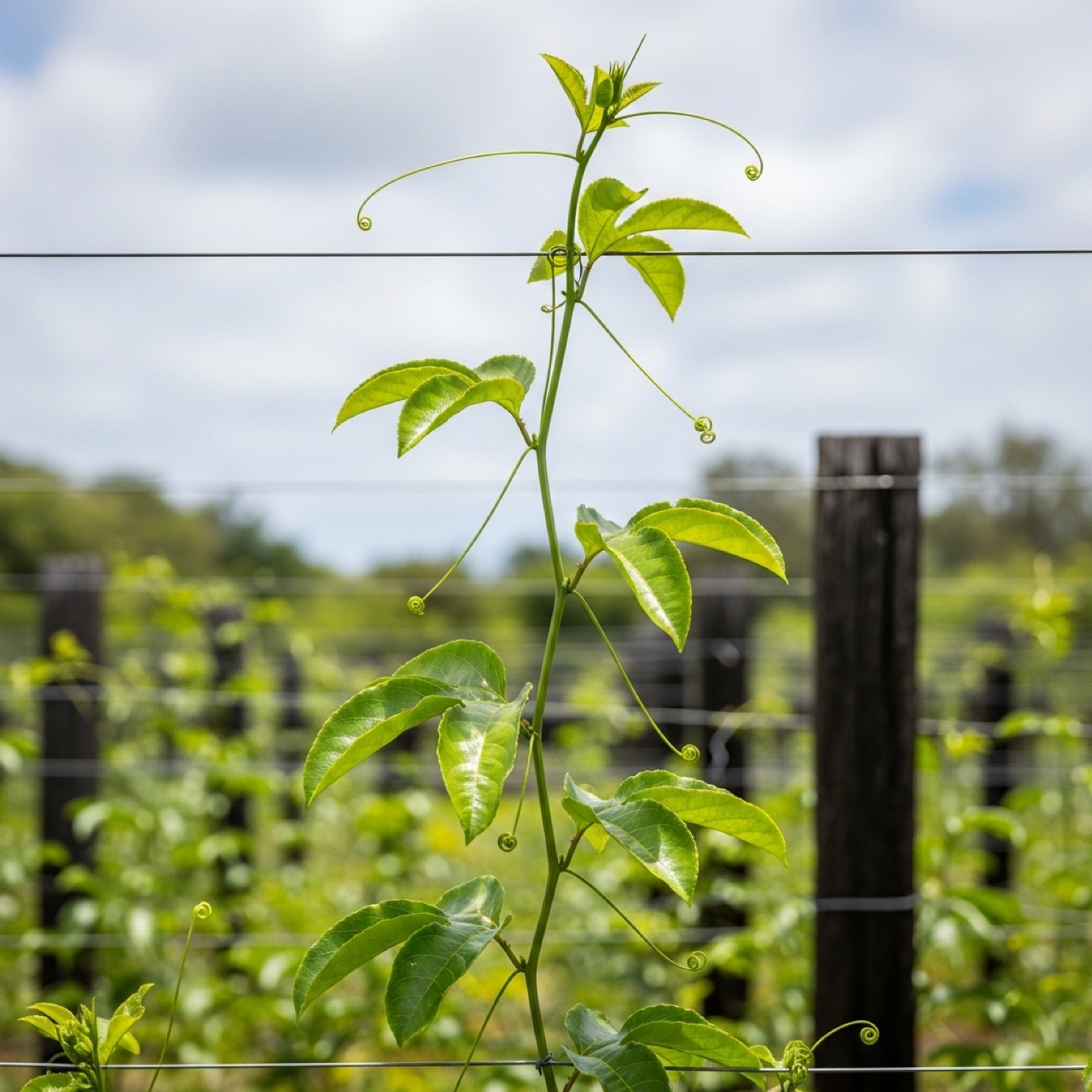
The critical rule: design for the final system from Day 1. Row spacing, orientation, post depth, and post spec should all match your eventual A-frame or pergola targets, even if the Year-1 wire configuration is simpler. Retrofitting wire is manageable; retrofitting posts is expensive.
Bottom line for Hawaii growers
The A-frame is the right primary system for most Hawaii yellow lilikoi operations. It delivers the sun protection tropical light demands, the yield premium that justifies its cost, and the harvest ergonomics that matter at Hawaii labor rates — and the 10-year math supports it clearly.
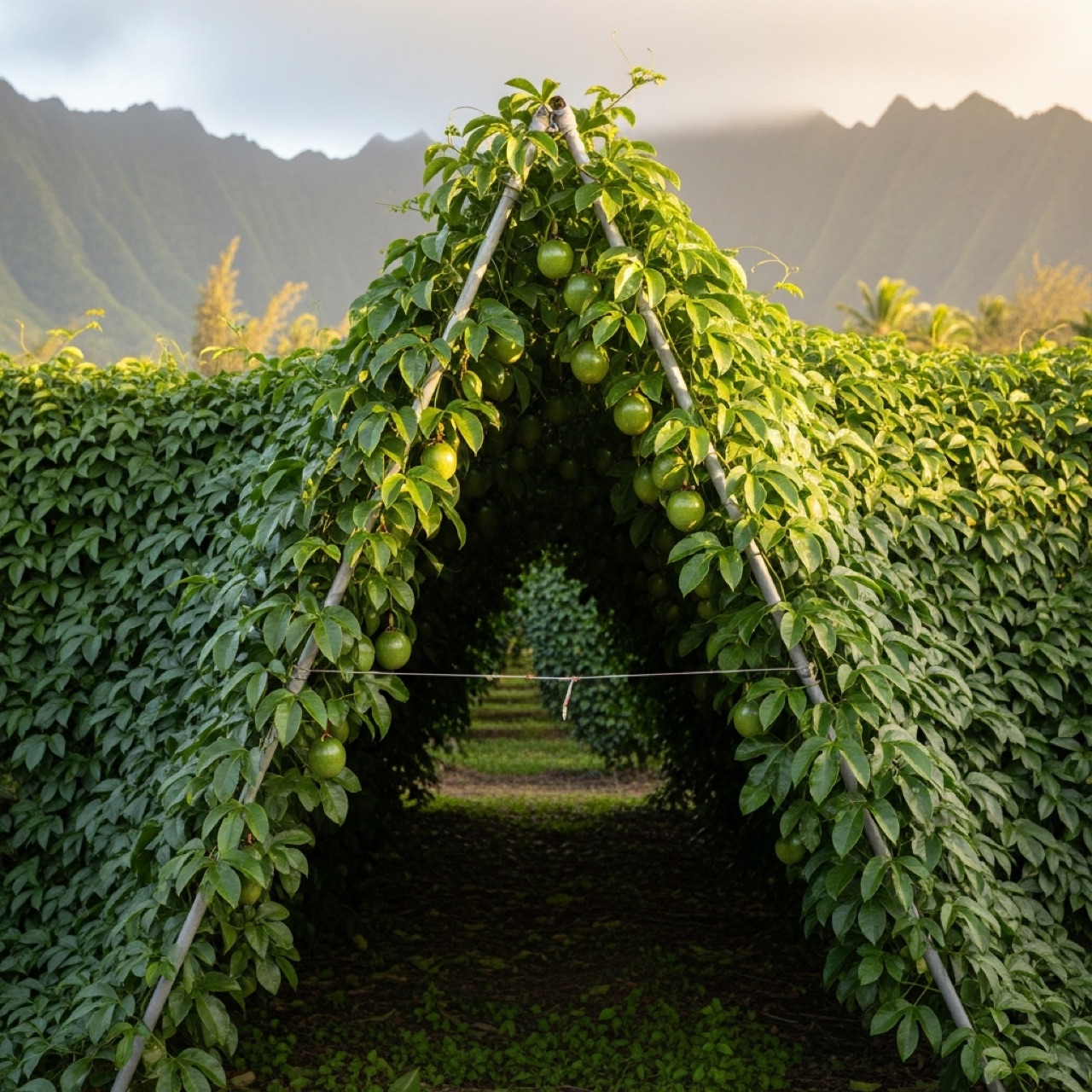
Start smaller if capital forces it, but build for where you're going. The vines you plant this year will still be producing eight years from now — make sure the infrastructure they're climbing was built for that horizon.
Curious what the ROI looks like on your specific acreage and trellis choice? The profit calculator ties the four systems to a 5-year proforma — change the trellis dropdown and watch the breakeven year move.
Sources
- Passion Fruit Australia — Best Management Practices for Passion Fruit Production
- University of Hawaii CTAHR Extension — trellis systems and training methods for passion fruit; Hawaii trial data
- UF/IFAS Extension — passion fruit production guidance (Florida baseline yields)
- EMBRAPA Cerrados — Brazilian intensive pergola production benchmarks
- USDA ARS — agricultural infrastructure and materials data
- Passion Fruit Research Project — Phase 4 economic model (yellow lilikoi, leeward Big Island, farm-gate pricing)
New articles every other Wednesday
Get each new piece in your inbox. No spam, unsubscribe anytime.