The Real Numbers Behind a Hawaii Passion Fruit Farm
By Brian
Hawaii is one of the best places on earth to grow passion fruit, and one of the most expensive. Knowing exactly where the money goes, and where it comes from, is the line between a business and an expensive hobby farm.
Here's the short version: budget about $20,000 per acre to establish a planting, $12,000–15,000 per acre per year to operate it once it's mature, and expect to sell fresh fruit at $8/lb direct or $4/lb wholesale. Labor eats 50–65% of your operating budget because Hawaii pays the highest farm wages in the country. The numbers work, but only if you model them as a 5–7 year build instead of a two-year flip.
Why Hawaii is different from every other market
Before the numbers, understand the structural forces that make Hawaii financially unusual — because they cut both ways.
The import restriction advantage. Only five countries are approved to export fresh passion fruit to the US. That's not a wide-open commodity market; it's a constrained supply environment where locally grown product faces far less price competition than you'd expect. Hawaii growers don't get steamrolled by imported volume the way strawberry or tomato growers do.
The "lilikoi" brand. This matters more than most growers realize. Lilikoi is culturally embedded here — shave ice, lilikoi butter, malasadas, cocktails. It's not just a flavor, it's a local identity marker tourists actively seek and residents pay up for. That brand equity supports farm-gate prices around $8/lb at farmers markets. Mainland specialty retailers, if you can solve the logistics, could support $8–15/lb.
Year-round production. Hawaii's climate enables two production cycles a year with the right management and variety selection. Florida gets one to two seasonal cycles; California is limited to a narrow geographic range. The annual revenue ceiling per acre is structurally higher here than in any mainland state.
Now for the costs that offset those advantages.
How much does it cost to start a passion fruit farm in Hawaii?
Establishment costs are the one-time investments to get from bare ground to first commercial harvest. In Hawaii they run substantially higher than mainland comparisons, for two reasons that show up in every line item: freight premiums on materials, and the highest farm wages in the country.
Labor reality check. Hawaii crop workers averaged $19.99/hour in the 2024 USDA survey. The 2025 H-2A Adverse Effect Wage Rate for Hawaii hit $20.08/hour — the highest AEWR of any state. Florida crop workers average around $15–16/hour. For any labor-intensive installation work, you're paying a 25–30% premium before you turn a shovel.
Freight reality check. Agricultural inputs — fertilizer, pesticides, irrigation materials, equipment — ship from the mainland. Ocean freight to Hawaii runs $5,000–16,000 per full container load, and major carriers raise rates 3–4% a year. Hawaii farmers cite shipping as one of the top barriers to expansion. Expect materials to cost roughly 20–25% more than mainland prices.
The trellis is your single biggest line item. A mid-range T-trellis with full drip irrigation runs about $20,000/acre as a baseline. Budget installations with simpler systems can target $13,500–15,000. Premium pergola systems with extensive site prep can reach $27,000–30,000/acre.
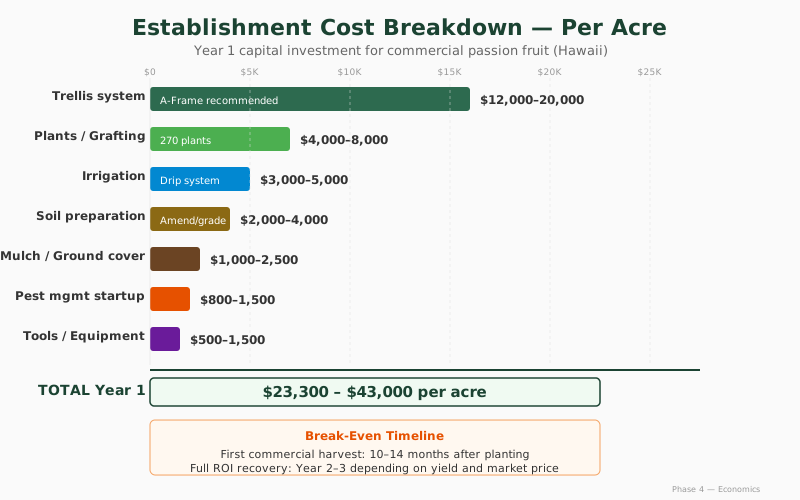
| Budget | Simpler trellis + drip | $13,500–15,000 |
| Mid-range (baseline) | T-trellis + full drip irrigation | ~$20,000 |
| Premium | Pergola + extensive site prep | $27,000–30,000 |
Multi-acre operations get some relief. Site prep and irrigation mainline infrastructure have economies of scale, and bulk purchases cut per-unit freight. A 5-acre operation typically runs 20–30% lower on a blended per-acre basis than a 1-acre planting.
Land. Hawaii State Agricultural Parks on the Big Island lease at roughly $150/acre/year — among the most affordable ag land in the state. Statewide cropland averages around $326/acre/year. For Big Island operations, $150–200/acre/year is a realistic lease target through the state ag park program.
What this means for your farm: the trellis decision sets your entire capital budget. Don't over-build a pergola system for a 1-acre premium-purple operation that will never need it, and don't under-build a budget trellis for a yellow planting that has to carry 15,000 lbs/acre of fruit load. Match the system to the variety and the volume, then add the Hawaii freight premium on top.
What are the annual operating costs per acre?
Once established (Year 2 and beyond), a mature planting in Hawaii runs about $12,000–15,000/acre per year in total operating costs. For reference, University of Florida IFAS estimates $8,000–10,000/acre for South Florida. The Hawaii premium is real and persistent.
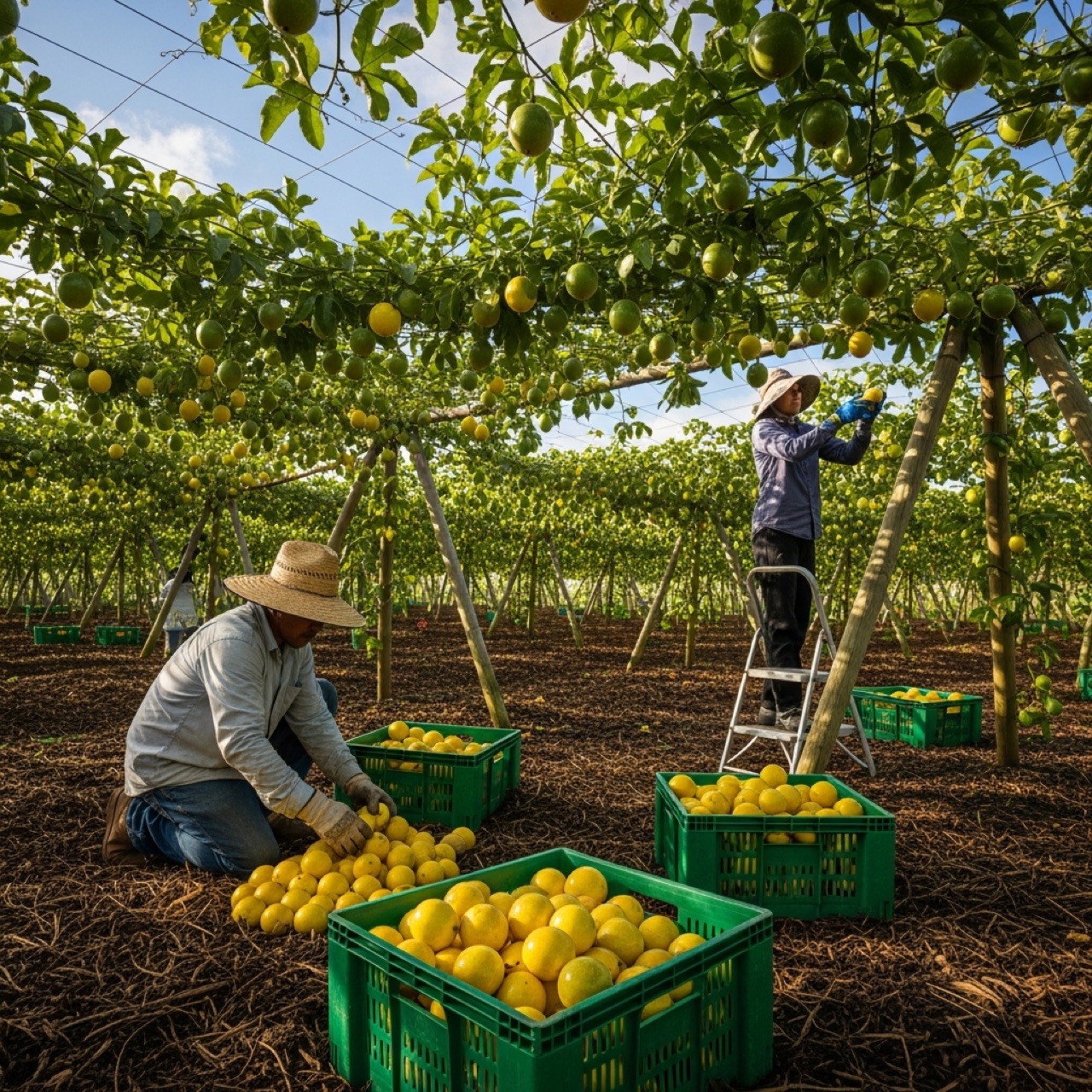
Labor is 50–65% of operating costs. The big annual labor activities are pruning and vine training, hand pollination (for yellow varieties), harvesting, and general maintenance. At $20/hour, the labor cost structure here is fundamentally different from any mainland analogy.
Year 1 yields are partial. First-year harvests typically run 30–60% of mature vine production. Full commercial yields are generally reached in Year 2–3. Any financial model that assumes full production in Year 1 is wrong, and that error is what kills otherwise-reasonable business plans.
Where the revenue can come from
Most Hawaii passion fruit farms run multiple revenue streams, not just fresh fruit. The economics improve sharply when you think in channels rather than a single product.
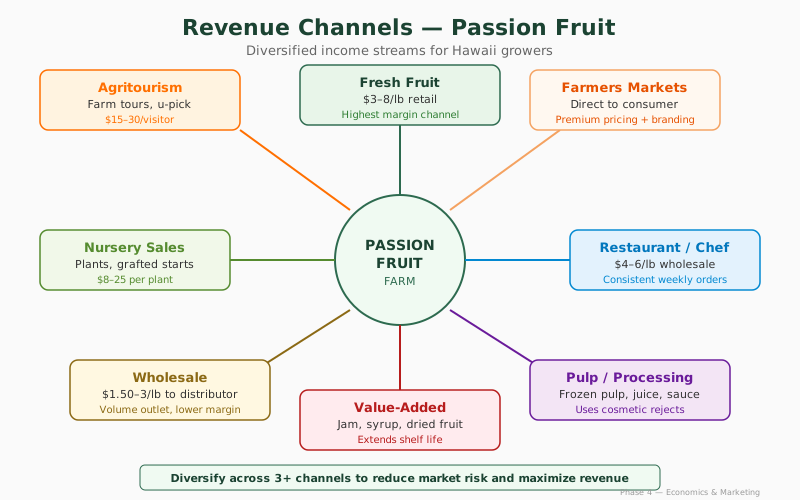
Farmers market direct sales are the highest-margin channel — around $8/lb at farm gate, no intermediary. The constraint is throughput; a market only absorbs so much weekly.
Restaurant and specialty retail supply creates consistent volume demand at ~$4/lb wholesale. Hawaii's farm-to-table restaurant culture is a real and growing market, but it demands reliability and consistent quality. UF/IFAS Extension report FE1129 documents mainland wholesale prices of just $0.90–1.30/lb — so Hawaii's protected market is sustaining roughly 4–5× the mainland wholesale price, a structural advantage driven by import restrictions and distance from competitors.
Value-added products — lilikoi butter, syrup, puree, juice concentrate — convert fresh fruit into shelf-stable goods with longer selling seasons, higher margins per pound, and online/mail-order potential. Processing adds cost and regulatory complexity but significantly expands reach.
Mainland export is the long game. Hawaii-grown premium lilikoi is distinct from anything grown on the mainland. The logistics are real — perishability, freight — but not unsolvable for dried products, juice, or frozen puree.
| Farmers market direct | $8/lb | Highest margin; limited weekly throughput |
| Restaurant / specialty retail | $4/lb | Consistent volume; needs reliability + quality |
| Mainland wholesale (for comparison) | $0.90–1.30/lb | UF/IFAS FE1129 — what Hawaii avoids competing against |
| Value-added | Higher per lb of fruit | Longer season, online potential, added complexity |
What this means for your farm: the channel mix matters as much as the yield. A grower moving everything through farmers markets at $7/lb earns several times what a grower dumping into wholesale does on the same harvest — but the market can only absorb so much. Plan a blend: direct sales for the premium, restaurants for steady volume, value-added to mop up the fruit you can't sell fresh fast enough.
How long until it breaks even?
Treat this as a 5–7 year business build, not a 2-year flip. But before any five-year projection, start with a real number from the ground — because the yield you plug in changes everything.
Run that real baseline through the numbers and the lesson is blunt. At ~2,250 lbs/acre sold at $8/lb retail, an unoptimized block grosses roughly $18,000/acre — but push it through wholesale at $4/lb and it barely clears the ~$13,500/acre it costs to operate, and never earns back the ~$20,000 establishment. Wide-spaced, unoptimized lilikoi is a break-even hobby. The profit lives entirely in raising the yield.
That's where the rest of this series comes in. Denser planting (Brazil runs vines at ~5-foot spacing, not 10), grafting onto resistant rootstock, and pollinating for fruit set are what move a planting from ~2,250 lbs/acre toward the 5,000–12,500 lbs/acre the big producers actually hit. So here's the same 5-year build modeled at a realistic optimized target of 5,000 lbs/acre** — still less than half of Brazil's national-plus benchmark — at a blended **$6/lb across a retail/wholesale mix:
| Year 1 | 40% (~2,000 lb) | ~$12,000 | ~$20,000 est. + ~$13,500 op | −$21,500 |
| Year 2 | 70% (~3,500 lb) | ~$21,000 | ~$13,500 op | −$14,000 |
| Year 3 | 100% (~5,000 lb) | ~$30,000 | ~$13,500 op | +$2,500 |
| Year 4 | 100% (~5,000 lb) | ~$30,000 | ~$13,500 op | +$19,000 |
| Year 5 | 100% (~5,000 lb) | ~$30,000 | ~$13,500 op | +$35,500 |
A grounded assessment
Hawaii passion fruit can work financially. Premium pricing, year-round production, and constrained import supply create real economic headroom. But establishment costs are substantial, labor costs don't relax, and the path to profitability runs through one of two doors: significant volume (which demands an effective pollination strategy) or premium channel management (which demands consistent quality and relationship-building).
The growers who succeed model it honestly and fund the build. Establishment costs are front-loaded, operating costs stabilize, and revenue scales as vines and channels mature. The numbers work. They just take time.
What this means for your farm: before you buy a single trellis post, write down your establishment budget, two years of operating costs, and your realistic blended price per pound. If those three numbers don't survive contact with a spreadsheet, fix the plan — not the spreadsheet.
Skip the spreadsheet — the profit calculator runs a configurable version of this model live: change acres, variety, trellis system, or channel mix and watch breakeven and 5-year cumulative net move with it. Set the yield honestly — that's the input that decides everything.
Sources
- USDA / US DOL — Agricultural Employment and Wage Report (AEWR), 2025 — Hawaii adverse effect wage rate $20.08/hr
- USDA NASS — crop worker wage survey, 2024 — Hawaii average $19.99/hr
- UF/IFAS Extension FE1129: Passion Fruit Production Budget Analysis — South Florida operating costs and wholesale price data
- Hawaii Department of Agriculture — agricultural land lease data and grower expansion-barrier survey
- Hawaii State Agricultural Parks — Big Island lease rate data ($150/acre/year)
- University of Hawaii CTAHR Extension — Hawaii passion fruit production benchmarks
- EMBRAPA Cerrados — passion fruit production research
- USDA ARS — post-harvest handling and Fusarium wilt research
New articles every other Wednesday
Get each new piece in your inbox. No spam, unsubscribe anytime.